
Del 2 i serien Inscriptions
Embodiment and Everyday Cyborgs
Technologies That Alter Subjectivity
Inbunden, Engelska, 2021
579 kr
Beställningsvara. Skickas inom 5-8 vardagar. Fri frakt för medlemmar vid köp för minst 249 kr.
Your organs are failing and require replacement. If you had the choice, would you prefer organs from other humans or non-human animals, or would you choose a ‘cybernetic’ medical implant?Using a range of social science methods and drawing on the sociology of the body and embodiment, biomedicine and technology, this book asks what happens to who we are (our identity) when we change what we are (our bodies)? From surveying young adults about whether they would choose options such as 3-D bioprinting, living or deceased human donation, or non-human animal or implantable biomechanical devices, to interviewing those who live with an implantable cardiac defibrillator, Haddow invites us to think about what kind of relationship we have with our bodies. She concludes that the reliance on ‘cybernetic’ medical devices create ‘everyday cyborgs’ who can experience alienation and new forms of vulnerability at implantation and activation.Embodiment and everyday cyborgs invites readers to consider the relationship between personal identity and the body, between humans and non-human animals, and our increasing dependency on ‘smart’ implantable technology. The creation of new techno-organic hybrid bodies makes us acutely aware of our own bodies and how ambiguous the experience of embodiment actually is. It is only through understanding how modifications such as transplantation, amputation and implantation make our bodies a ‘presence’ to us, Haddow argues, that we realise our everyday experience of our bodies as an absence.An electronic edition of this book is freely available under a Creative Commons (CC BY-NC-ND) licence.
Produktinformation
- Utgivningsdatum2021-05-25
- Mått138 x 216 x 16 mm
- Vikt417 g
- FormatInbunden
- SpråkEngelska
- SerieInscriptions
- Antal sidor208
- FörlagManchester University Press
- ISBN9781526114181
Tillhör följande kategorier
Hoppa över listan


Mer från samma serie
Del 3
Del 1
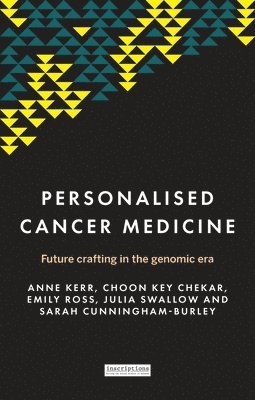
Personalised Cancer Medicine
Anne Kerr, Choon Key Chekar, Emily Ross, Julia Swallow, Sarah Cunningham-Burley
Inbunden, 2021
579 kr
Del 3
Del 4
Del 5
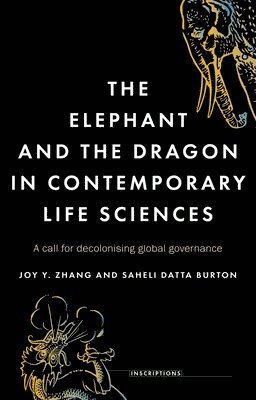
Elephant and the Dragon in Contemporary Life Sciences
Joy Y. Zhang, Saheli Datta Burton
Inbunden, 2022
1 559 kr
Del 7
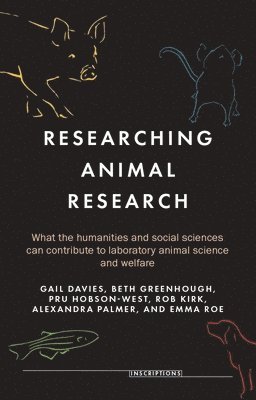
Researching Animal Research
Gail Davies, Beth Greenhough, Pru Hobson-West, Robert G. W. Kirk, Alexandra Palmer, Emma Roe
Inbunden, 2024
559 kr
Del 4
Del 8
Del 9
Del 5
Elephant and the Dragon in Contemporary Life Sciences
Joy Y. Zhang, Saheli Datta Burton
Häftad, 2024
459 kr
Hoppa över listan


Du kanske också är intresserad av
- Nyhet
Del 3
Del 5
Elephant and the Dragon in Contemporary Life Sciences
Joy Y. Zhang, Saheli Datta Burton
Inbunden, 2022
1 559 kr
Del 4
Del 9
Del 4
Del 10
Del 3
Del 8
Del 5
Elephant and the Dragon in Contemporary Life Sciences
Joy Y. Zhang, Saheli Datta Burton
Häftad, 2024
459 kr