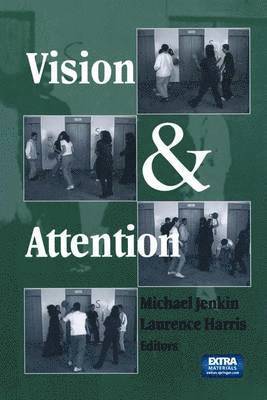
Vision and Attention
Häftad, Engelska, 2012
2 119 kr
Beställningsvara. Skickas inom 10-15 vardagar
Fri frakt för medlemmar vid köp för minst 249 kr.It has become apparent that vision is not a passive process working on the retinal image like a film to record a perfect copy as the perception. The book will appeal to vision scientists as well as to people involved in using visual processes in computer animations, display design or the sensory systems of machines.
Produktinformation
- Utgivningsdatum2012-08-18
- Mått155 x 235 x 19 mm
- Vikt511 g
- FormatHäftad
- SpråkEngelska
- Antal sidor316
- FörlagSpringer-Verlag New York Inc.
- ISBN9781468495201
Tillhör följande kategorier
- 1 Vision and Attention.- 1.1 What Is Attention?.- 1.2 Selective Visual Attention.- 1.3 Parsing Attention. Is Attention Central to the Act of Seeing or is it Merely a Servant Carrying its Master to the Right Place?.- 1.4 Directing Attention.- 1.5 Conclusions.- 2 Shifts of Attention and Saccades Are Very Similar. Are They Causally Linked?.- 2.1 Spatial Attributes of Attention.- 2.2 Coordinate Space of Focal Attention.- 2.3 Overt and Covert Orientation.- 2.4 Top-Down versus Bottom-Up Attentional Control.- 2.5 Shifting Attention.- 2.6 Coupling Between Saccadic Eye Movements and Attentional Shifts.- 2.7 Adaptive Control of Saccadic Eye Movements.- 2.8 Nature of the Error Signal.- 2.9 Are Shifts of Attention also Adaptable?.- 2.10 Might Attention Provide an Error Signal to Saccade-Gain Adaptation?.- 3 Contrast Gain, Area Summation and Temporal Tuning in Primate Visual Cortex.- 3.1 Introduction.- 3.2 Gain Control.- 3.3 Contrast-Gain Control.- 3.4 Beyond the Classical Receptive Field.- 3.5 Area Summation and Contrast.- 3.6 Temporal Tuning and Contrast.- 3.7 Temporal Tuning and Contrast in V1.- 3.8 Discussion.- 4 Global Processes in Form Vision and Their Relationship to Spatial Attention.- 4.1 Introduction to the Ventral Visual Pathway.- 4.2 Components of Intermediate Form Analysis.- 4.3 Changing Views of V4.- 4.4 Evidence for Global Orientation Pooling in Human Vision.- 4.5 Neural Model for Configurai Units.- 4.6 Configural Units and Receptive Field Size.- 4.7 Evidence Pointing to Configurai Units in V4 in the Human Brain.- 4.8 Application of V4 Model Units to Faces.- 4.9 Selective Attention.- 4.10 Summary and Overview.- 5 Visual Attention: The Active Vision Perspective.- 5.1 Introduction.- 5.2 Active Vision.- 5.3 Reading.- 5.4 Scenes and Objects.- 5.5 Search.- 5.6 Rethinking Covert Attention.- 5.7 Conclusion.- 6 Complexity, Vision, and Attention.- 6.1 What Is Computational Complexity?.- 6.2 Can Perception Be Modeled Computationally?.- 6.3 Visual Search.- 6.4 Complexity Level Analysis of Vision.- 6.5 The Selective-Tuning Model of Visual Attention.- 6.6 Conclusions.- 7 Motion-Disparity Interaction and the Scaling of Stereoscopic Disparity.- 7.1 Cue Combination in Depth Perception.- 7.2 Depth Scaling.- 7.3 Stereomotion Interaction for Depth Scaling.- 7.4 Summary.- 8 Signal Detection and Attention in Systems Governed By Multiplicative Noise.- 8.1 Introduction.- 8.2 Signal Detection Theory for Ideal and Non-ideal Observers.- 8.3 Distraction Theory.- 8.4 Effects of Multiplicative Noise.- 9 Change Blindness: Implications for the Nature of Visual Attention.- 9.1 Visual Attention: Role in Scene Perception.- 9.2 Visual Attention: Mechanisms.- 9.3 Concluding Remarks.- 10 The Role of Expectations in Change Detection and Attentional Capture.- 10.1 Change Blindness.- 10.2 Attentional Capture.- 10.3 Conclusions.- 11 Attention, Eye Movements, and Neurons: Linking Physiology and Behavior.- 11.1 Introduction.- 11.2 Attention and Saccades.- 11.3 Frontal Eye Field.- 11.4 Bottom-Up Influences on Visual Selection.- 11.5 Top-Down Influences on Visual Selection.- 11.6 Conclusions.- 12 Vision and Action in Virtual Environments: Modern Psychophysics in Spatial Cognition Research.- 12.1 Introduction.- 12.2 Biological Cybernetics.- 12.3 Enabling Technologies.- 12.4 Stimulus Control.- 12.5 Stimulus Relevance.- 12.6 Spatial Cognition in VEs.- 12.7 Concluding Remarks.- 13 Selective Feature-Based Attention Directed to a Pair of Lines: Psychophysical Evidence and a Psychophysical Model.- 13.1 Does the Visual System Contain Long-Distance Comparators with Orthogonal Orientation Difference and Mean-Orientation Labels?.- 13.2 Does the Visual System Contain Long Distance Comparators Whose Outputs Carry Orthogonal Mean-Location and Separation Labels?.- 13.3 Does the Visual System Contain Long-Distance Comparator Mechanisms Whose Outputs Carry Orthogonal Orientation Difference, Mean Orientation, Mean Location and Separation Labels?.- 13.4 How Do Discrimination Thresholds for Orientation Difference, Mean Orientation, Separation, and Relative Mean Location Vary as a Function of Contrast?.- 13.5 Attentional Implications and a Psychophysical Model.- 14 Thoughts on Change Blindness.- 14.1 Introduction.- 14.2 Thoughts on Normal Viewing: Where and What.- 14.3 The “Where” and “What” Components of Change Detection.- 14.4 Thoughts on Disruptions.- 14.5 Other Issues Concerning the Theory.- 14.6 Conclusion.- Author Index.