
Del 9 i serien Screen Cultures: German Film and the Visual
Counter-Cinema of the Berlin School
Häftad, Engelska, 2015
539 kr
Beställningsvara. Skickas inom 5-8 vardagar. Fri frakt för medlemmar vid köp för minst 249 kr.
The first book-length study in any language of the "Berlin School," the most significant filmmaking movement to come out of Germany since the 1970s.WINNER: 2014 German Studies Association AwardThe contemporary German directors collectively known as the "Berlin School" constitute the most significant filmmaking movement to come out of Germany since the New German Cinema of the 1970s, not least because their films mark the emergence of a new film language. The Berlin School filmmakers, including Christian Petzold, Thomas Arslan, Angela Schanelec, Christoph Hochhäusler, Ulrich Köhler, Benjamin Heisenberg, Maren Ade, and Valeska Grisebach, are reminiscent of the directors of the New German Autorenkino and of French cinéma des auteurs of the 1960s.This is the first book-length study of the Berlin School in any language. Its central thesis - that the movement should be regarded as a "counter-cinema" - is built around the unusual style of realism employed in its films, a realism that presents images of a Germany that does not yet exist. Abel concludes that it is precisely how these films' images and sounds work that renders them political: they are political not because they are message-driven films but because they are made politically, thus performing a "redistribution of the sensible" - a direct artistic intervention in the way politics partitions ways of doing and making, saying and seeing.Marco Abel is Professor of English and Film Studies at the University of Nebraska, Lincoln.
Produktinformation
- Utgivningsdatum2015-07-15
- Mått152 x 229 x 21 mm
- Vikt538 g
- FormatHäftad
- SpråkEngelska
- SerieScreen Cultures: German Film and the Visual
- Antal sidor360
- FörlagBoydell & Brewer Ltd
- ISBN9781571139412
Hoppa över listan





Mer från samma författare
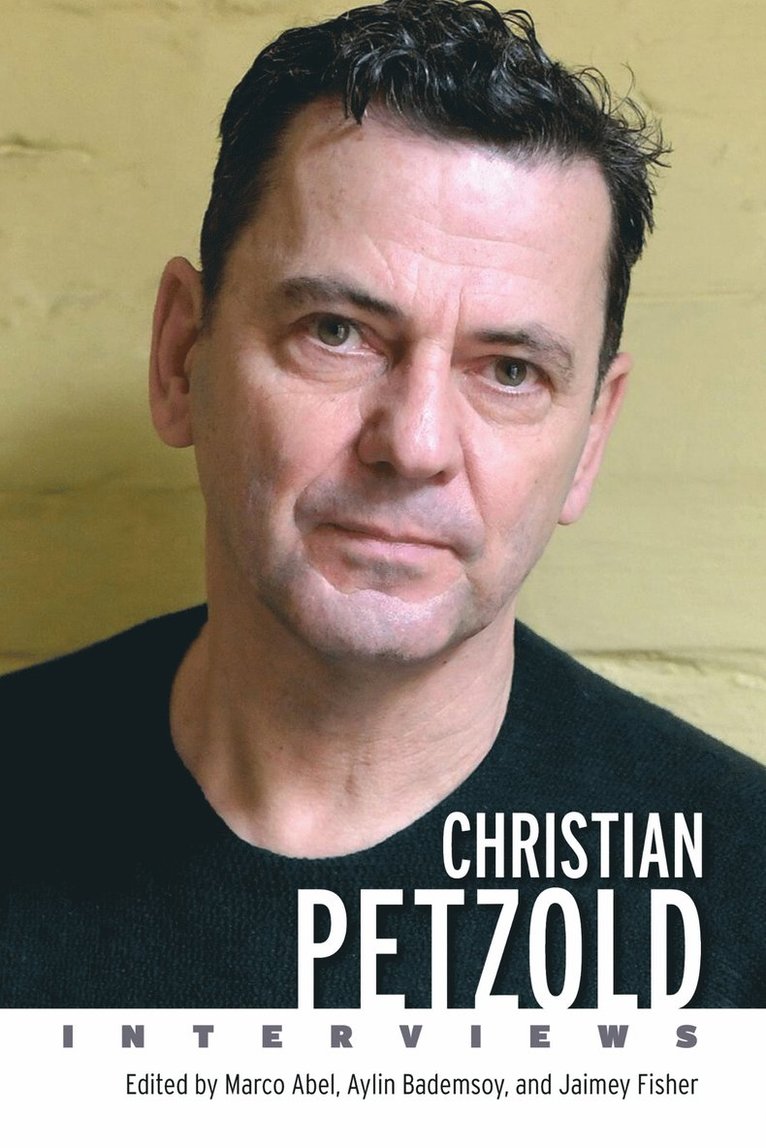
Christian Petzold
Marco, Abel, Marco Abel, Marco Abel, Aylin Bademsoy, Jaimey Fisher
Inbunden, 2023
1 699 kr
Christian Petzold
Marco, Abel, Marco Abel, Marco Abel, Aylin Bademsoy, Jaimey Fisher
Häftad, 2023
449 kr
Del 20
Hoppa över listan




Mer från samma serie
Del 3
After the Avant-Garde
Randall, Halle, Randall Halle, Randall Norman Halle, Reinhild Steingröver
Inbunden, 2008
2 049 kr
Del 6
Del 7
Del 2
Del 5
Del 1
Del 10
Del 8
Del 18
Del 12
Hoppa över listan
Du kanske också är intresserad av
Christian Petzold
Marco, Abel, Marco Abel, Marco Abel, Aylin Bademsoy, Jaimey Fisher
Inbunden, 2023
1 699 kr
Del 20
Christian Petzold
Marco, Abel, Marco Abel, Marco Abel, Aylin Bademsoy, Jaimey Fisher
Häftad, 2023
449 kr
Del 19