
Del i serien SUNY series in Chinese Philosophy and Culture
Timing and Rulership in Master Lü's Spring and Autumn Annals (Lüshi chunqiu)
Inbunden, Engelska, 2002
1 409 kr
Tillfälligt slut
Explores proper timing and the arts of rulership in the work that inspired China's first emperor.Master Lü's Spring and Autumn Annals (Lüshi chunqiu) inspired the king who united the warring states to become China's first emperor. In this work on the Lüshi chunqiu, author James D. Sellmann finds that the concept of "proper timing" makes the work's diverse philosophies coherent. He discusses the life and times of its author, Lü Buwei, and the structure of the work. Sellmann also analyzes the role of human nature, the justification of the state, and the significance of cosmic, historical, and personal timing in the Lüshi chunqiu. An organic instrumentalist position begins to emerge from the diverse theories of the Lüshi chunqiu. In conclusion, Sellmann looks at the implications of the syncretic philosophies of the Lüshi chunqiu for contemporary conceptions of time, human nature, political order, and social and environmental ethics.
Produktinformation
- Utgivningsdatum2002-03-21
- Mått153 x 229 x 15 mm
- Vikt490 g
- FormatInbunden
- SpråkEngelska
- SerieSUNY series in Chinese Philosophy and Culture
- Antal sidor277
- FörlagState University of New York Press
- ISBN9780791452318
Tillhör följande kategorier
Hoppa över listan
Mer från samma författare
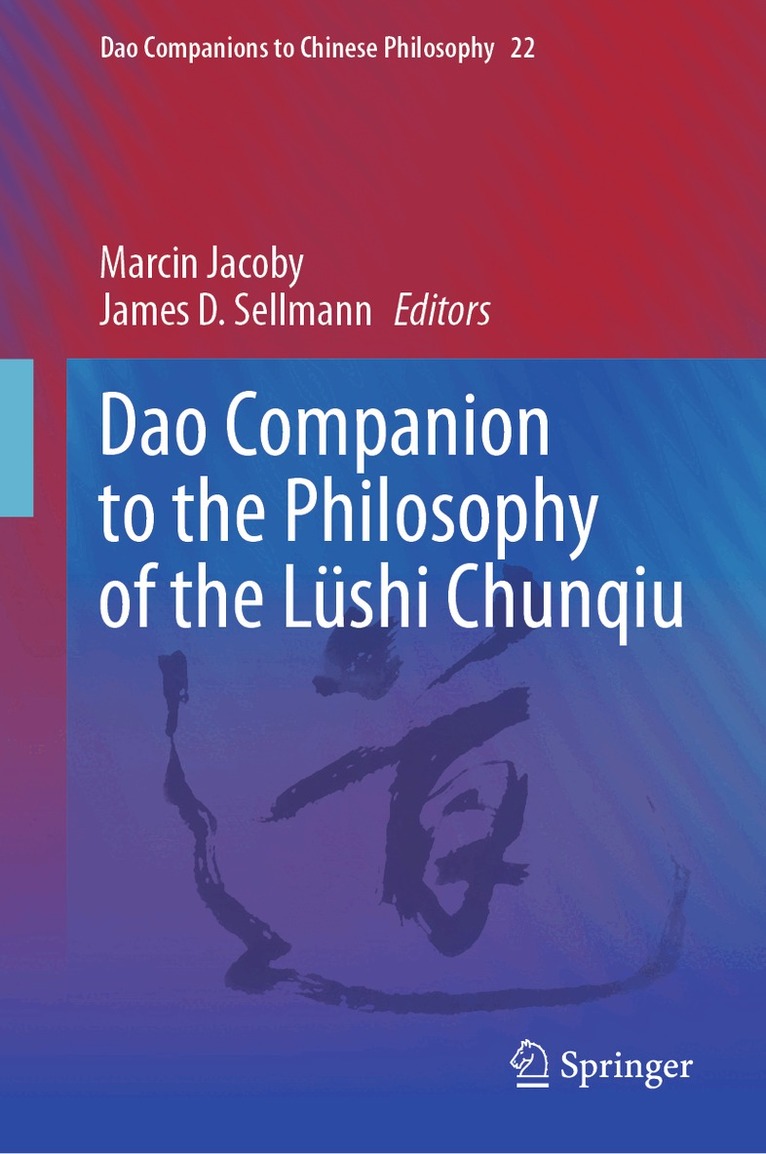
Dao Companion to the Philosophy of the Lüshi Chunqiu
Marcin Jacoby, James D. Sellmann
Inbunden, 2026
3 769 kr
Hoppa över listan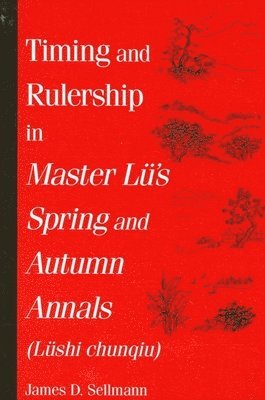







Du kanske också är intresserad av
Timing and Rulership in Master Lü's Spring and Autumn Annals (Lüshi chunqiu)
James D. Sellmann
Häftad, 2002
509 kr
Dao Companion to the Philosophy of the Lüshi Chunqiu
Marcin Jacoby, James D. Sellmann
Inbunden, 2026
3 769 kr
- Nyhet
Del 3
- Nyhet
Del 11
- Nyhet
- Nyhet
Del 4
Del 2
Del 1
- Nyhet
Del 4