
Del i serien Elements in Indo-Pacific Security
Theorizing Hedging
Explaining Shifts and Variations in Alignment Choices
Häftad, Engelska, 2026
389 kr
Beställningsvara. Skickas inom 5-8 vardagar. Fri frakt för medlemmar vid köp för minst 249 kr.
Finns i fler format (1)
Hedging, not balancing or bandwagoning, is the modal behavior of the non-great powers under uncertainty. Despite its prevalence as a state alignment choice, hedging has remained an undertheorized subject in the study of international relations. This Element presents one of the first theoretical works on strategic hedging in world politics. Tracing the multidisciplinary roots of hedging as an instinctive human behavior, I contend that sovereign actors hedge in ways similar to commodity traders, farmers, fund managers, academic writers, politicians, and individuals in competitive organizations under conditions of high-stakes and high-uncertainties. I then develop a two-level theoretical framework to explain when, how and why states hedge, rather than balance or bandwagon. Using selected Indo-Pacific countries as empirical cases, I conclude that while structural-level conditions largely explain the shifts in alignment decisions (e.g., from non-hedging to hedging, or vice versa), domestic factors explain the variations in hedging choices.
Produktinformation
- Utgivningsdatum2026-07-16
- Mått229 x 152 x 10 mm
- Vikt184 g
- FormatHäftad
- SpråkEngelska
- SerieElements in Indo-Pacific Security
- Antal sidor75
- FörlagCambridge University Press
- ISBN9781009589413
Tillhör följande kategorier
Hoppa över listan
Mer från samma serie
Factional Politics in the Liberal Democratic Party
Michael J. Gigante, Ming Wan
Inbunden, 2025
1 059 kr
Hoppa över listan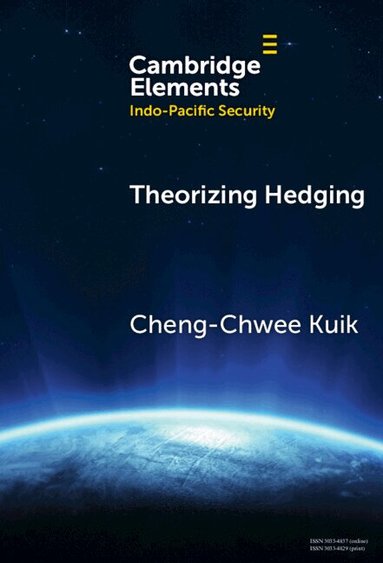


Du kanske också är intresserad av
Decolonizing Security in East Asia
Chih-yu Shih, Chiung-Chiu Huang, Yih-Jye Hwang
Inbunden, 2026
1 219 kr
- Nyhet
Del 7