
Theoretical, Practical, and Economic Prospects of Carbon Capture, Utilization, and Storage
Häftad, Engelska, 2027
2 699 kr
Kommande
Theoretical, Practical, and Economic Prospects of Carbon Capture, Utilization, and Storage provides a comprehensive and multidisciplinary treatment of the technologies and considerations driving the deployment of carbon capture, utilization, and storage (CCUS) solutions.
Covering the full CCUS value chain, the book examines carbon capture methods, CO2 compression and transportation, CO2 utilization pathways, including enhanced oil recovery (EOR), and long-term geological storage and sequestration technologies. Alongside technical foundations, it explores the engineering, economic, operational, environmental, regulatory, and implementation challenges and strategies that influence project success.
Drawing on real-world examples and case studies, the text bridges theory and practice, helping readers evaluate the technical feasibility, economic viability, environmental performance, and long-term sustainability of CCUS projects in diverse settings. Designed for engineers, researchers, consultants, industry professionals, students, and policymakers, it offers both foundational knowledge and insight into current developments shaping the field. The book also introduces techno-economic assessment, life-cycle cost analysis, process optimization, and emerging digital approaches, including artificial intelligence and machine learning, for evaluating and improving CCUS systems. By integrating technical and economic perspectives, the book supports informed decision-making and effective management of CCUS initiatives aimed at reducing industrial carbon emissions and supporting the transition toward low-carbon and net-zero energy systems.
Covering the full CCUS value chain, the book examines carbon capture methods, CO2 compression and transportation, CO2 utilization pathways, including enhanced oil recovery (EOR), and long-term geological storage and sequestration technologies. Alongside technical foundations, it explores the engineering, economic, operational, environmental, regulatory, and implementation challenges and strategies that influence project success.
Drawing on real-world examples and case studies, the text bridges theory and practice, helping readers evaluate the technical feasibility, economic viability, environmental performance, and long-term sustainability of CCUS projects in diverse settings. Designed for engineers, researchers, consultants, industry professionals, students, and policymakers, it offers both foundational knowledge and insight into current developments shaping the field. The book also introduces techno-economic assessment, life-cycle cost analysis, process optimization, and emerging digital approaches, including artificial intelligence and machine learning, for evaluating and improving CCUS systems. By integrating technical and economic perspectives, the book supports informed decision-making and effective management of CCUS initiatives aimed at reducing industrial carbon emissions and supporting the transition toward low-carbon and net-zero energy systems.
- Covers the complete CCUS value chain, from carbon capture to utilization and long-term geological storage
- Combines technical foundations with engineering design, practical applications, and implementation considerations
- Includes real-world case studies illustrating successful CCUS projects and technologies
- Examines technical, economic, operational, environmental, and regulatory factors affecting project feasibility
- Introduces techno-economic assessment, life-cycle cost analysis, process optimization, and emerging digital tools, including artificial intelligence and machine learning, for CCUS applications
Produktinformation
- Utgivningsdatum2027-03-01
- Mått152 x 229 x undefined mm
- Vikt450 g
- FormatHäftad
- SpråkEngelska
- SerieWoodhead Publishing Series on Carbon Capture and Storage
- Antal sidor300
- FörlagElsevier Science
- ISBN9780443442971
Tillhör följande kategorier
Hoppa över listan




Mer från samma författare
Asphaltene Deposition Control by Chemical Inhibitors
Ali Ghamartale, Shokufe Afzali, Nima Rezaei, Sohrab Zendehboudi
Häftad, 2021
2 359 kr
Hydrogen Production, Transportation, Storage, and Utilization
Sohrab Zendehboudi, Bahram Ghorbani
Häftad, 2025
2 199 kr
Hoppa över listan
Mer från samma serie
Circular Economy Processes for CO2 Capture and Utilization
Francisco M. Baena-Moreno, Judith Gonz�lez-Arias, Tom�s Ram�rez-Reina, Laura Pastor-P�rez
Häftad, 2023
2 459 kr
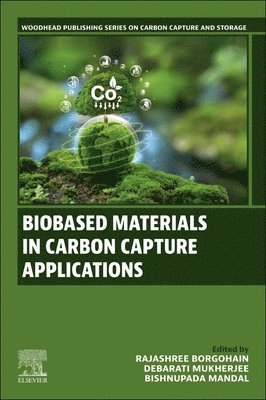
Biobased Materials in Carbon Capture Applications
Rajashree Borgohain, Debarati Mukherjee, Bishnupada Mandal
Häftad, 2026
2 569 kr
Thermal Plasma-Coupled Carbon Capture Utilization and Storage
Vineet S. Sikarwar, Apoorva Ranjekar, Guido Van Oost
Häftad, 2026
2 679 kr
Hoppa över listan
Du kanske också är intresserad av
Hydrogen Production, Transportation, Storage, and Utilization
Sohrab Zendehboudi, Bahram Ghorbani
Häftad, 2025
2 199 kr
Asphaltene Deposition Control by Chemical Inhibitors
Ali Ghamartale, Shokufe Afzali, Nima Rezaei, Sohrab Zendehboudi
Häftad, 2021
2 359 kr
Biobased Materials in Carbon Capture Applications
Rajashree Borgohain, Debarati Mukherjee, Bishnupada Mandal
Häftad, 2026
2 569 kr
Circular Economy Processes for CO2 Capture and Utilization
Francisco M. Baena-Moreno, Judith Gonz�lez-Arias, Tom�s Ram�rez-Reina, Laura Pastor-P�rez
Häftad, 2023
2 459 kr
Thermal Plasma-Coupled Carbon Capture Utilization and Storage
Vineet S. Sikarwar, Apoorva Ranjekar, Guido Van Oost
Häftad, 2026
2 679 kr