
Del i serien Routledge International Handbooks
Routledge Handbook of Political Corruption
Häftad, Engelska, 2018
1 089 kr
Beställningsvara. Skickas inom 10-15 vardagar. Fri frakt för medlemmar vid köp för minst 249 kr.
Since the early 1990s, a series of major scandals in both the financial and most especially the political world has resulted in close attention being paid to the issue of corruption and its links to political legitimacy and stability. Indeed, in many countries – in both the developed as well as the developing world – corruption seems to have become almost an obsession. Concern about corruption has become a powerful policy narrative: the explanation of last resort for a whole range of failures and disappointments in the fields of politics, economics and culture. In the more established democracies, worries about corruption have become enmeshed in a wider debate about trust in the political class. Corruption remains as widespread today, possibly even more so, as it was when concerted international attention started being devoted to the issue following the end of the Cold War.This Handbook provides a showcase of the most innovative and exciting research being conducted in Europe and North America in the field of political corruption, as well as providing a new point of reference for all who are interested in the topic. The Handbook is structured around four core themes in the study of corruption in the contemporary world: understanding and defining the nature of corruption; identifying its causes; measuring its extent; and analysing its consequences. Each of these themes is addressed from various perspectives in the first four sections of the Handbook, whilst the fifth section explores new directions that are emerging in corruption research. The contributors are experts in their field, working across a range of different social-science perspectives.
Produktinformation
- Utgivningsdatum2018-03-13
- Mått174 x 246 x 12 mm
- Vikt700 g
- FormatHäftad
- SpråkEngelska
- SerieRoutledge International Handbooks
- Antal sidor380
- FörlagTaylor & Francis Ltd
- ISBN9781138594890
Tillhör följande kategorier
Hoppa över listan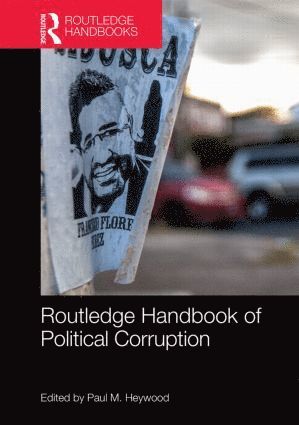




Du kanske också är intresserad av
Research into Secondary School Curricula
Paul Heywood, Kenneth Wain, James Calleja
Inbunden, 1994
2 269 kr
- Nyhet
Del 3
- Nyhet
Del 11
- Nyhet
Del 6
- Nyhet
Del 4
Del 3
Del 1