
Del 99
Residential Change and Demographic Challenge
The Inner City of East Central Europe in the 21st Century
Häftad, Engelska, 2016
1 089 kr
Beställningsvara. Skickas inom 10-15 vardagar. Fri frakt för medlemmar vid köp för minst 249 kr.
Finns i fler format (1)
Going beyond the assumption that East Central European cities are still 'in transition' this book draws on the postsocialism paradigm to ask new questions about the impact of demographic change on residential developments in this region. Focussing on four second-order cities in this region, it examines Gdansk and Lódz in Poland and Brno and Ostrava in the Czech Republic as examples and deals with the nexus between urban development and demographic change for the context of East Central European cities. It provides a framework for linking urban and demographic research. It discusses how residential areas and urban developments cope with changes in population development, household types and different forms of in- and out-migration and goes on to explore parallels and differences in comparison with broader European patterns. This book will be useful to academics of urban planning and development especially in transition areas, Central and Eastern European studies, demographics and population studies, and sociology/social exclusion.
Produktinformation
- Utgivningsdatum2016-11-11
- Mått156 x 234 x 20 mm
- Vikt700 g
- FormatHäftad
- SpråkEngelska
- Antal sidor376
- FörlagTaylor & Francis Ltd
- ISBN9781138254435
Tillhör följande kategorier
Hoppa över listan

Mer från samma författare
Geographie ländlicher Räume
Ulrike Grabski-Kieron, Stefan Kordel, Christian Krajewski, Ingo Mose, Annett Steinführer
Häftad, 2024
609 kr
Hoppa över listan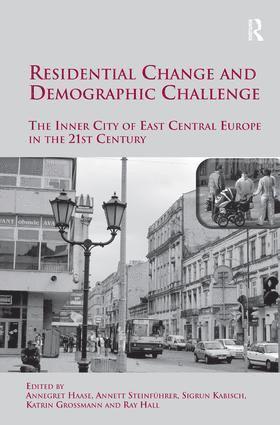



Du kanske också är intresserad av
Residential Change and Demographic Challenge
Annett Steinführer, Sigrun Kabisch, Katrin Grossmann, Annegret Haase
Inbunden, 2011
3 209 kr
Del 10
Urban Transformations
Sigrun Kabisch, Florian Koch, Erik Gawel, Annegret Haase, Sonja Knapp, Kerstin Krellenberg, Jaime Nivala, Andreas Zehnsdorf
Häftad, 2018
1 649 kr
Del 10
Urban Transformations
Sigrun Kabisch, Florian Koch, Erik Gawel, Annegret Haase, Sonja Knapp, Kerstin Krellenberg, Jaime Nivala, Andreas Zehnsdorf
Inbunden, 2018
2 289 kr
Del 99
Geographie ländlicher Räume
Ulrike Grabski-Kieron, Stefan Kordel, Christian Krajewski, Ingo Mose, Annett Steinführer
Häftad, 2024
609 kr
Energie und soziale Ungleichheit
Katrin Großmann, André Schaffrin, Christian Smigiel
Häftad, 2016
869 kr
Del 18
Mittelalterliche Sprache Und Literatur in Eisenach Und Erfurt
Thomas Bein, Martin Schubert, Jürgen Wolf, Annegret Haase
Häftad, 2007
1 029 kr
deutsche Malagis nach den Heidelberger Handschriften Cpg 340 und 315
Annegret Haase, Rudolf Bentzinger, Gilbert A R De Smet, Bob W Th Duijvestijn
Inbunden, 2000
4 089 kr