
Del i serien Control, Robotics and Sensors
Recent Trends in Sliding Mode Control
Inbunden, Engelska, 2016
2 849 kr
Beställningsvara. Skickas inom 3-6 vardagar. Fri frakt för medlemmar vid köp för minst 249 kr.
In control theory, sliding mode control, or SMC, is a nonlinear control method that alters the dynamics of a nonlinear system by application of a discontinuous control signal that forces the system to 'slide' along a cross-section of the system's normal behaviour. This book describes recent advances in the theory, properties, methods and applications of SMC.The book is organised into four parts. The first part is devoted to the design of higher-order sliding-mode controllers, with specific designs presented in the context of disturbance rejection by means of observation and identification. The second part offers a set of tools for establishing different dynamic properties of systems with discontinuous right-hand sides. Time discretization is addressed in the third part. First-order sliding modes are discretized using an implicit scheme - higher-order sliding-mode differentiators, typically used in output-feedback schemes, are discretized in such a way that the optimal accuracy of their continuous-time counterparts is restored.The last part is dedicated to applications. In the context of energy conversion, sliding-mode control is applied to variable-speed wind turbines, fuel cell coupled to a power converter, rugged DC series motors and rectifiers with unity power factor, and electropneumatic actuator. Finally, an event-triggered sliding-mode scheme is proposed for networked control systems subject to packet loss, jitter and delayed transmissions.
Produktinformation
- Utgivningsdatum2016-04-28
- Mått156 x 234 x 28 mm
- Vikt824 g
- FormatInbunden
- SpråkEngelska
- SerieControl, Robotics and Sensors
- Antal sidor440
- FörlagInstitution of Engineering and Technology
- ISBN9781785610769
Tillhör följande kategorier
Hoppa över listan
Du kanske också är intresserad av
Del 490
Sliding-Mode Control and Variable-Structure Systems
Tiago Roux Oliveira, Leonid Fridman, Liu Hsu
Häftad, 2024
3 159 kr
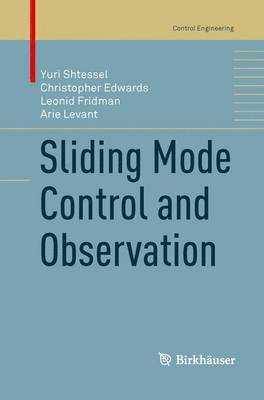
Sliding Mode Control and Observation
Yuri Shtessel, Christopher Edwards, Leonid Fridman, Arie Levant
Inbunden, 2013
1 579 kr
Robust Output LQ Optimal Control via Integral Sliding Modes
Leonid Fridman, Alexander Poznyak, Francisco Javier Bejarano
Inbunden, 2014
719 kr
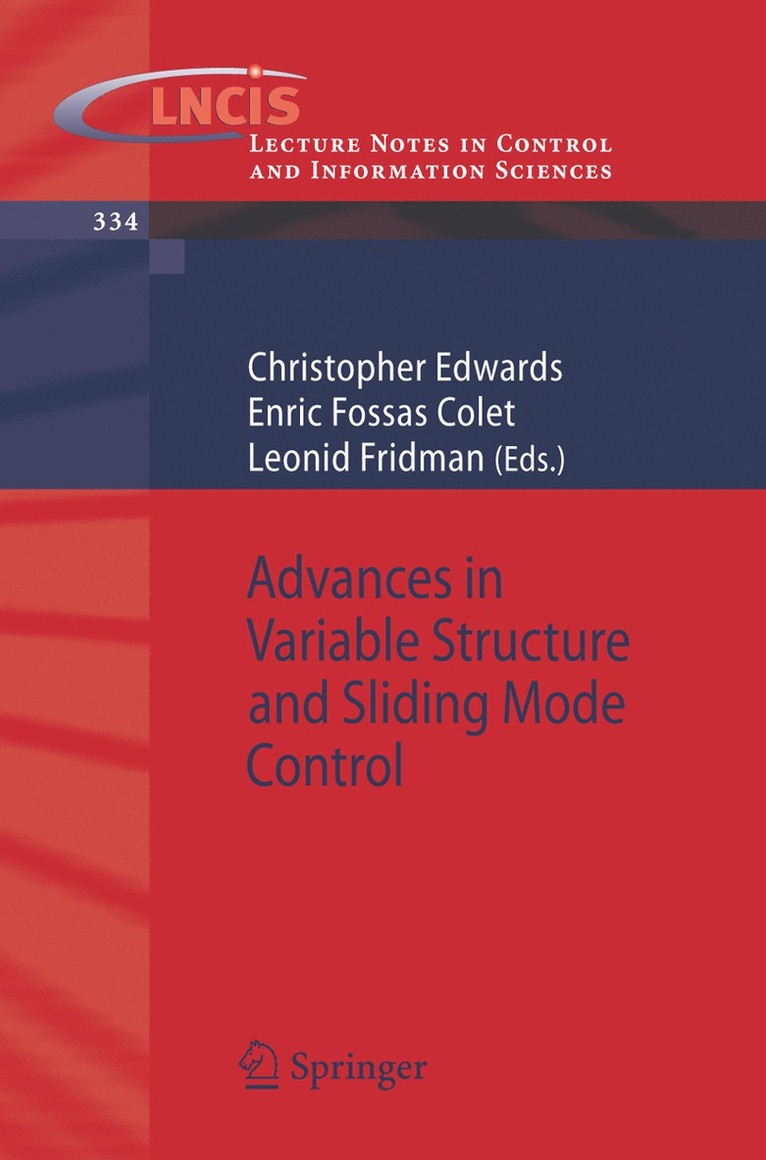
Del 334
Advances in Variable Structure and Sliding Mode Control
Christopher Edwards, Enric Fossas Colet, Leonid Fridman
Häftad, 2006
2 159 kr
Sliding Mode Control and Observation
Yuri Shtessel, Christopher Edwards, Leonid Fridman, Arie Levant
Häftad, 2015
1 159 kr
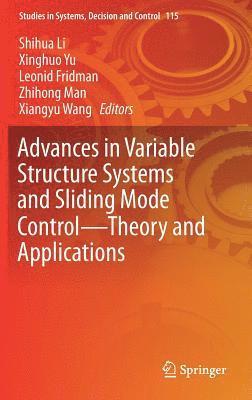
Del 115
Advances in Variable Structure Systems and Sliding Mode Control—Theory and Applications
Shihua Li, Xinghuo Yu, Leonid Fridman, Zhihong Man, Xiangyu Wang
Inbunden, 2017
1 439 kr
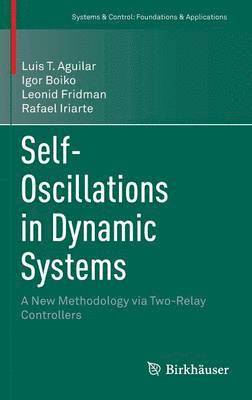
Self-Oscillations in Dynamic Systems
Luis T. Aguilar, Igor Boiko, Leonid Fridman, Rafael Iriarte
Inbunden, 2015
729 kr
Del 412
Sliding Modes after the first Decade of the 21st Century
Leonid Fridman, Jaime Moreno, Rafael Iriarte
Häftad, 2011
2 159 kr