
Rapid Review of Chemistry for the Life Sciences and Engineering
With Select Applications
Häftad, Engelska, 2023
959 kr
Beställningsvara. Skickas inom 10-15 vardagar. Fri frakt för medlemmar vid köp för minst 249 kr.
Finns i fler format (1)
Designed to demystify chemistry for the non-chemist, Rapid Review of Chemistry for the Life Sciences and Engineering is a useful reference manual for life scientists and engineers, who may have forgotten a formula, principle, or concept in the college chemistry taken a few years ago. With over 100 solved examples, from balancing chemical reactions, doing stoichiometry, and understanding nomenclature rules in both organic and inorganic chemistry, to calculating half-lives in kinetics or radioactive decay schemes, understanding colligative properties of solutions, and interpreting toxicities of hazardous materials, this book is intended to make reviewing and understanding chemistry much clearer and easier. Relevant diagrams are in color and solved examples are organized by subject/topic and cross-referenced by page and chapter number.It may also serve as a concise go-to sidekick for students, who are not chemistry majors, taking chemistry at the college level and having difficulty understanding the scope, focus, language, or equations in their chemistry textbook. Armed with select, contemporary applications, it is written in the hope to bridge a gap between chemists and non-chemists, so that they may communicate with and understand each other. Chapters 1-10 are designed to contain the standard material in an introductory college chemistry course. Chapters 11-15 present applications of chemistry that should interest and appeal to scientists and engineers engaged in a variety of fields.Additional featuresMore than 100 solved examples clearly illustrated and explained with SI units and conversion to other units using conversion tables includedAssists the reader to understand organic and inorganic compounds along with their structures, including isomers, enantiomers, and congeners of organic compoundsProvides a quick and easy access to basic chemical concepts and specific examples of solved problemsIdeal sidekick for students who are non-chemistry majors taking intro. college chemistry, needing clear, concise explanationsThis concise, user-friendly review of general and organic chemistry with environmental applications will be of interest to all disciplines and backgrounds.
Produktinformation
- Utgivningsdatum2023-09-25
- Mått156 x 234 x undefined mm
- Vikt453 g
- FormatHäftad
- SpråkEngelska
- Antal sidor275
- FörlagTaylor & Francis Ltd
- ISBN9780367552794
Tillhör följande kategorier
Hoppa över listan
Mer från samma författare
Applied Chemistry for Environmental Engineering
Armen S. Casparian, Gergely Sirokman
Häftad, 2016
989 kr
Hoppa över listan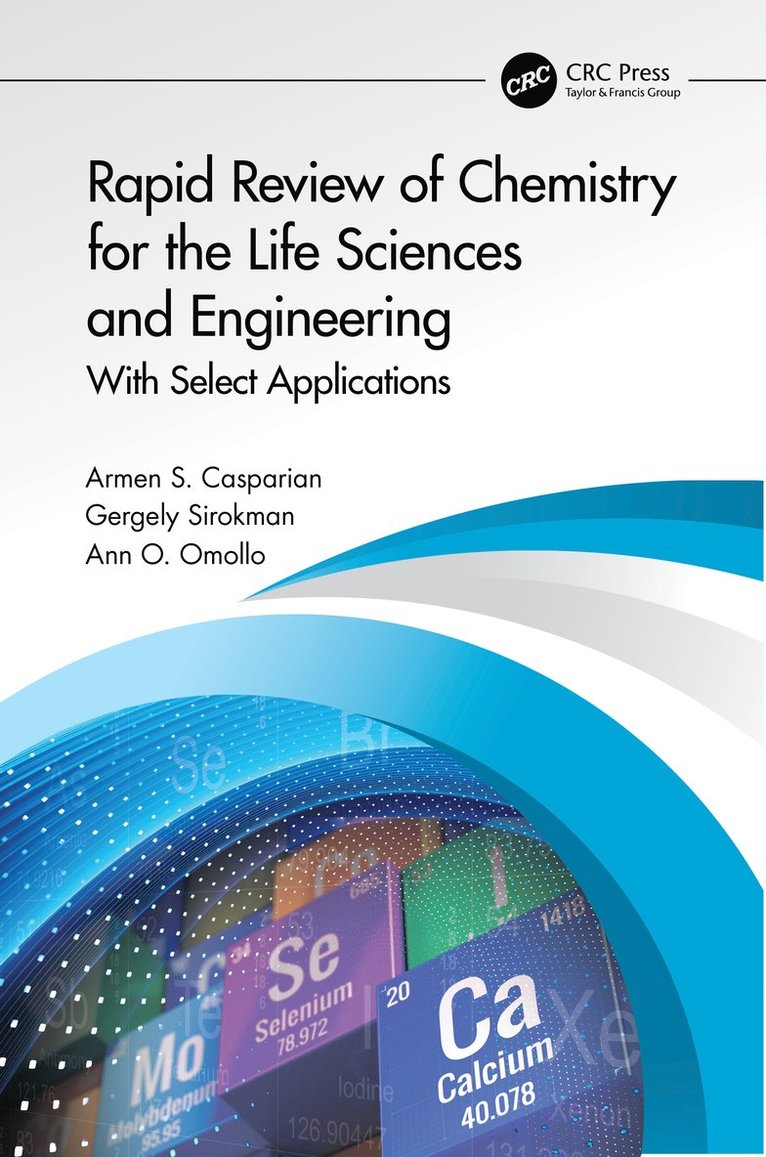






Du kanske också är intresserad av
Rapid Review of Chemistry for the Life Sciences and Engineering
Armen S. Casparian, Gergely Sirokman, Ann Omollo
Inbunden, 2021
2 809 kr
Applied Chemistry for Environmental Engineering
Armen S. Casparian, Gergely Sirokman
Häftad, 2016
989 kr
Environmental Engineering Dictionary of Technical Terms and Phrases
Francis J. Hopcroft, Gergely Sirokman
Häftad, 2017
659 kr
- Nyhet
Del 11
- Nyhet
Del 3
- Nyhet
- Nyhet
Del 6
- Nyhet
Del 4
Del 1