
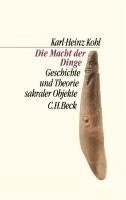
Powerful Things
The History and Theory of Sacred Objects
Inbunden, Engelska, 2020
1 249 kr
Beställningsvara. Skickas inom 5-8 vardagar. Fri frakt för medlemmar vid köp för minst 249 kr.
We both give meanings to, and derive our own meanings from, the multitude of objects we live amongst. Trivial things remind us of past loves; old things embody an idealized past; on other things we believe our fate depends. In this book, Karl-Heinz Kohl describes relationships to sacred objects from the viewpoint of anthropology and the history of religion, showing how people of all cultures ascribe quite immeasurable value to things and make their own destiny dependent on these objects.During their voyages of discovery, Portuguese seafarers came across Africans who attributed mysterious powers to objects that became known as 'fetishes', and the concept of 'fetishism' soon cast a spell over European thinkers. The Church condemned it as the work of the devil, while for the philosophers of the Enlightenment it proved that no religion was rational at heart. But the fascination remained - Hegel, Comte, Marx and Freud - each of them tried to solve the riddle of fetishism in their own way. And it is fetishism that is the starting point for this book, which offers nothing less than a comprehensive theory of the sacred object,from the stone cult of ancient Israel and the Bible's prohibition on images, to the medieval cult of reliquaries, Native American sacred bundles, magical figures of the BaKongo, and the idols of the Ancient Greeks. Tracing the fate of ancient cult images since their rediscovery in the Renaissance, Kohl comes to a striking conclusion: in the secularized societies of the Global North, it is the museum cult that is the bastion of contemporary fetishism.'[Karl-Heinz Kohl] is undisputedly one of the best-known German anthropologists and one of the most sought-after interlocutors for all those who still think ethnology is a voice worth listening to.'Peter Probst (Tufts University), Zeitschrift fur Ethnologie'Karl-Heinz Kohl's work shows very clearly that it is very revealing not to always focus primarily on the actors in a culture, but rather to focus on things as actors: the thing -sacred or banal - is obviously more alive than we think.'Dorothee Kimmich (Karl-Eberhard University), Frankfurter Rundschau. 'We must be grateful to Karl-Heinz Kohl for having written a book that while dealing with 'the power of things', approaches these objects from a comparative perspective, indebted as much to ethnographic accounts, as to philosophical, economic and psychoanalytic theory.Gustavo Benavides (Villanova University), Numen
Produktinformation
- Utgivningsdatum2020-12-15
- Mått156 x 234 x 14 mm
- Vikt513 g
- FormatInbunden
- SpråkEngelska
- Antal sidor238
- FörlagSean Kingston Publishing
- ISBN9781912385249
Tillhör följande kategorier
Hoppa över listan




Mer från samma författare
Handbuch religionswissenschaftlicher Grundbegriffe (HrwG). 5 Bände
Hubert Cancik, Burkhard Gladigow, Karl-Heinz Kohl
Inbunden, 2021
6 489 kr
Hoppa över listan



Du kanske också är intresserad av
Handbuch religionswissenschaftlicher Grundbegriffe (HrwG). 5 Bände
Hubert Cancik, Burkhard Gladigow, Karl-Heinz Kohl
Inbunden, 2021
6 489 kr
- Nyhet
Del 11
- Nyhet
Del 3
- Nyhet
Del 1
- Nyhet
Del 1