
Del 37 i serien Cambridge Classical Texts and Commentaries
Plato: Clitophon
Häftad, Engelska, 2006
1 039 kr
Beställningsvara. Skickas inom 5-8 vardagar. Fri frakt för medlemmar vid köp för minst 249 kr.
Finns i fler format (1)
The Clitophon, a dialogue generally ascribed to Plato, is significant for focusing on Socrates' role as an exhorter of other people to engage in philosophy. It was almost certainly intended to bear closely on Plato's Republic and is a fascinating specimen of the philosophical protreptic, an important genre very fashionable at the time. This 1999 volume is a critical edition of this dialogue, in which Professor Slings provides a text based on an examination of all relevant manuscripts and accompanies it with a translation. His extensive introduction studies philosophical exhortation in the classical era, and tries to account for Plato's dialogues in general as a special type of exhortation. The Clitophon is seen as a defence of the Platonic dialogue. The commentary elucidates the Greek and discusses many passages where the meaning is not entirely clear.
Produktinformation
- Utgivningsdatum2006-11-02
- Mått138 x 216 x 25 mm
- Vikt498 g
- FormatHäftad
- SpråkEngelska
- SerieCambridge Classical Texts and Commentaries
- Antal sidor380
- FörlagCambridge University Press
- ISBN9780521031066
Tillhör följande kategorier
Hoppa över listan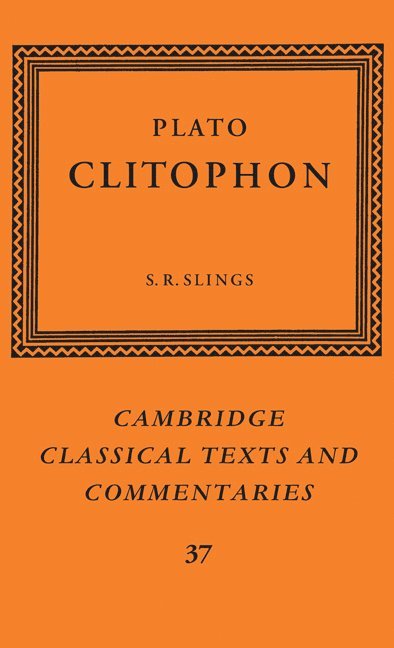







Du kanske också är intresserad av
Del 37
- Nyhet
Del 3
- Nyhet
Del 11
- Nyhet
Del 4
- Nyhet
Del 6
Del 1
Del 3
Del 2
Del 7