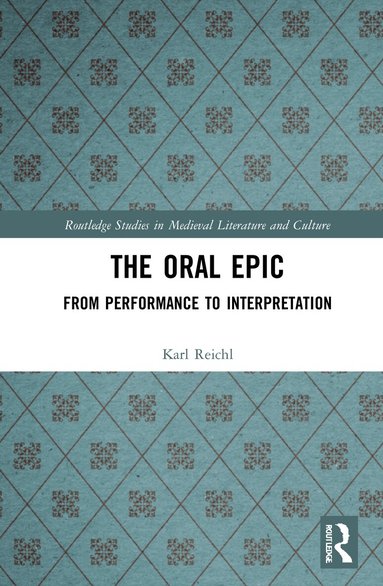
Underlying The Oral Epic: From Performance to Interpretation are Reichl’s pioneering labor of many decades to inform research on orality in medieval European literatures by means of his extensive fieldwork with Central Asian Turkic oral bards (Parry’s first and unrealized choice as ethnographic subjects to test his path-breaking theory of Homeric composition) and his grounding in musicology, ethnology and otherwise. The book goes beyond this basis, however. It is one of the most broadly comparative single-authored syntheses of research yet produced on living or recently living oral epic traditions worldwide. [...] This book skillfully blends two seemingly contrasting virtues, ambition and brevity. Jargon is used but explained very clearly in the process. This theoretical and methodological guide will be equally valuable to advanced scholars and students. It needs to be widely used, thrust in rucksacks, not just acquired by libraries; to that end, the publisher might consider making the paperback edition more affordably priced.”Professor Daniel Prior, Miami University, Ohio, Journal of American Folklore, Volume 137, Number 544, Spring 2024, pp. 257-259.In The Oral Epic: From Performance to Interpretation, Reichl offers a synthesis of knowledge he has gained through a lifetime’s study of both the early epic poems of Europe—which we know only through texts—and the less familiar living epic traditions of other parts of the world. While most of his examples pertain to his fieldwork among Turkic-speaking peoples, Reichl is a comparatist by training and conviction, so that what he has to say about any one example fills out one’s understanding of the oral epic genre. At the same time, he avoids generalities that would obscure the unique character of different poems, traditions, or individual singers, each of which is grounded in a culturally specific context. The book consolidates Reichl’s place as the leading contemporary heir of such prior scholars as the Russian Turkologists Friedrich Wilhelm Radloff and Viktor Zhirmunsky and the American classicists and comparatists Milman Parry and Albert B. Lord. [...] A noteworthy strength of this book is the author’s equanimity in navigating between past and present, East and West, text and voice, polished literature and folk literature, the visionary English poet William Blake and the shaman-like epic singers of Central Asia, all the while making this kind of remarkable synthesis look easy. Anyone who wonders how folkloric scholarship that meets the highest standards of professionalism can be combined with other virtues—good sense, readability, a gift for colorful anecdotes, and an urbane awareness of the place of folkloric studies amidst a much larger world of letters—can turn to this compact yet major survey as a model.Professor John D. Niles, Emeritus, University of Wisconsin, Madison, Western Folklore, Vol. 82, No. 1 – Winter 2023I heartily recommend The Oral Epic to anyone interested in performance traditions of verbal art. Whereas performance-oriented approaches to verbal art have tended to focus on linguistic behavior as socially situated, Reichl’s book advocates a performer-centered approach, weighting concerns for performance as embodied activity and its reception through the materialities of embodied experience. The book is designed to be read as a book, with chapters of limited and balanced length written in a pleasant, accessible style, revealing the nuanced and perceptive understanding of a learned scholar. Each chapter balances the background or theoretical discussions of the relevant topic with engaging examples and illustrations that reveal the remarkable diversity of epic traditions’ manifestations in different cultures, milieux, and social situations. This book will be of value and interest to anyone interested in oral performance traditions of verbal art and storytelling.Docent Frog, Ph. D., University of Helsinki, Department of Cultures, Fabula, 66 (July) 2025 (De Gruyter)