OFDM-Based Broadband Wireless Networks
Design and Optimization
1 889 kr
Beställningsvara. Skickas inom 5-8 vardagar. Fri frakt för medlemmar vid köp för minst 249 kr.
Produktinformation
- Utgivningsdatum2005-11-22
- Mått160 x 241 x 18 mm
- Vikt485 g
- FormatInbunden
- SpråkEngelska
- Antal sidor262
- FörlagJohn Wiley & Sons Inc
- ISBN9780471723462
Tillhör följande kategorier
HUI LIU, PhD, is Associate Professor in the Electrical Engineering Department at the University of Washington. Dr. Liu has published more than forty journal articles and holds eighteen awarded or pending patents. He founded Broadstorm Inc. in 2000 and developed the world's first OFDMA-based mobile broadband system. He is the author of Signal Processing Applications in CDMA Communications and is the General Chairman for the 2005 Asilomar Conference on Signals, Systems, and Computers. GUOQING LI, PhD, is a Research Scientist in the Communication Technology Lab of Intel, where she works on broadband wireless technologies. Previously, Dr. Li worked as a senior system engineer at UTStarcom, developing algorithms for physical, multiple access control, radio link control, and radio resource control layers for 3G-WCDMA and IS-95 networks. Dr. Li has published more than twenty journal articles and conference papers.
- Preface. 1. Introduction.1.1 OFDM-based wireless network overview.1.1.1 Digital broadcasting and DVB-T.1.1.2 Wireless LAN and IEEE 802.11.1.1.3 WiMAX and IEEE 802.16.1.2 The need for "cross-layer" design.1.3 Organization of this text.2. OFDM Fundamentals.2.1 Broadband radio channel characteristics.2.1.1 Envelope fading.2.1.2 Time dispersive channel.2.1.3 Frequency dispersive channel.2.1.4 Statistical characteristics of broadband channels.2.2 Canonical form of broadband transmission.2.3 OFDM realization.2.4 Summary.3. PHY Layer Issues - System Imperfections.3.1 Frequency synchronization.3.1.1 OFDM carrier offset data mode.3.1.2 Pilot-based estimation.3.1.3 Non-pilot based estimation..3.2 Channel estimation.3.2.1 Pilots for 2D OFDM channel estimation .3.2.2 2DMMSE channel estimation.3.2.3 Reduced complexity channel estimation.3.3 I/Q imbalance compensation.3.3.1 I/Q Imbalance Model.3.3.2 Digital compensation receiver.3.3.3 Frequency offset estimation with I/Q imbalance.3.4 Phase noise compensation.3.4.1 Mathematical models for phase noise.3.4.2 CPE estimation with channel state information.3.4.3 Time domain channel estimation in the presence of CPE.3.4.4 CPE estimation without explicit CSI.3.5 Summary.4. PHY Layer Issues - Spatial Processing.4.1 Antenna array fundamentals.4.2 Beam forming.4.2.1 Coherent combining.4.2.2 Zero-forcing.4.2.3 MMSE reception (optimum linear receiver).4.2.4 SDMA.4.2.5 Broadband beam forming.4.3 MIMO channels and capacity.4.4 Space-time coding.4.4.1 Spatial multiplexing.4.4.2 Orthogonal space-time block coding.4.4.3 Concatenated ST transmitter.4.4.4 Beam forming with ST coding.4.4.5 ST beam forming in OFDM.4.5 Wide-area MIMO beam forming.4.5.1 Data model.4.5.2 Uncoded OFDM design criterion.4.5.3 Coded OFDM design criterion.4.6 Summary.4.7 Appendix I: Derivation of Pe.4.8 Appendix II: Proof of Proposition 5.4.9 Appendix III: Proof of Proposition 6.5. Multiple Access Control Protocols.5.1 Introduction.5.2 Basic MAC protocols.5.2.1 Contention based protocols.5.2.2 Non-contention based MAC protocols.5.3 OFDMA advantages.5.4 Multiuser diversity.5.5 OFDMA optimality.5.5.1 Multiuser multicarrier SISO systems.5.5.2 Multiuser multicarrierMIMO systems.5.6 Summary.5.7 Appendix I: Cn(p) is a convex function in OFDMA/SISO case.5.8 Appendix II: C(p) is a convex function in OFDMA/MIMO case.6. OFDMA Design Considerations.6.1 Cross layer design introduction.6.2 Mobility-dependent OFDMA traffic channels.6.2.1 OFDMA traffic channel.6.2.2 System model.6.2.3 Channel configuration for fixed/portable applications.6.2.4 Channel configuration for mobile application.6.3 IEEE 802.16e traffic channels.6.4 Summary.7. Frequency Planning in Multi-cell Networks.7.1 Introduction.7.1.1 Fixed channel allocation.7.1.2 Dynamic channel allocation.7.2 OFDMA DCA.7.2.1 Protocol design.7.2.2 Problem formulation for the RNC.7.2.3 Problem formulation for BSs.7.2.4 Fast algorithm for the RNC.7.2.5 Fast algorithm for BSs.7.3 Spectrum efficiency under different cell/sector configurations.7.3.1 System configuration and signaling overhead.7.3.2 Channel loading gains.7.4 Summary.8. Appendix..8.1 IEEE 802.11 and WiFi.8.1.1 802.11 overview.8.1.2 802.11 network architecture.8.1.3 The MAC layer technologies.8.1.4 The physical layer technologies.8.2 IEEE 802.16e and Mobile WiMAX.8.2.1 Overview.8.2.2 The physical layer technologies.8.2.3 The MAC layer technologies.8.3 Performance analysis of WiMAX systems.8.3.1 WiMAX OFDMA-TDD.8.3.2 Comparison Method.Notations and Acronym.About the Authors.Index.
Mer från samma författare
Setting Standards for Industry: Comparing the Emerging Chinese Standardization System and the Current US System
Hui Liu, Carl F. Cargill
219 kr
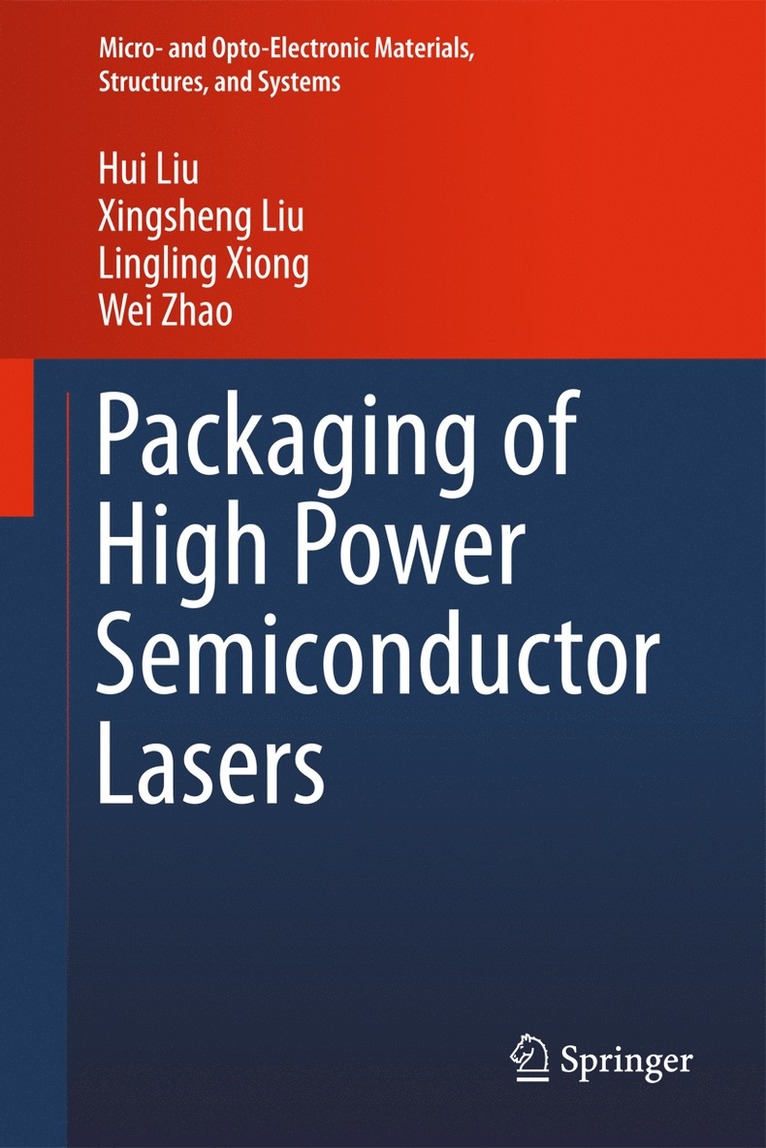
Packaging of High Power Semiconductor Lasers
Xingsheng Liu, Wei Zhao, Lingling Xiong, Hui Liu
2 359 kr
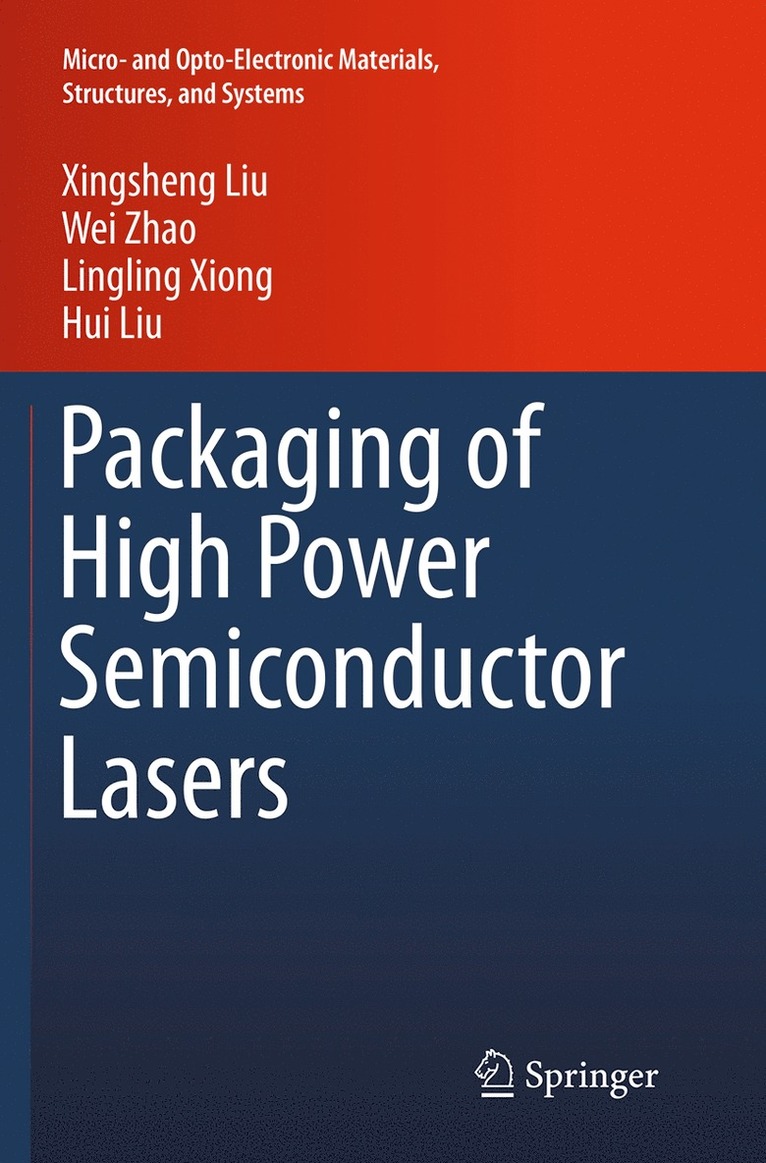
Packaging of High Power Semiconductor Lasers
Xingsheng Liu, Wei Zhao, Lingling Xiong, Hui Liu
2 359 kr
Biomedical Engineering Systems and Technologies
Maria Pedro Guarino, Kazuhiro Hotta, Malik Yousef, Hui Liu, Giovanni Saggio, Hannes Schlieter, Ana Fred, Hugo Gamboa
1 179 kr
Du kanske också är intresserad av
Proceedings of 2024 International Conference on Artificial Intelligence and Autonomous Transportation
Limin Jia, Dongxiu Ou, Hui Liu, Fang Zong, Pangwei Wang, Mingfang Zhang
4 149 kr
Advances in Condensed Matter Optics
Liangyao Chen, Ning Dai, Xunya Jiang, Kuijuan Jin, Hui Liu, Haibin Zhao
2 869 kr
Packaging of High Power Semiconductor Lasers
Xingsheng Liu, Wei Zhao, Lingling Xiong, Hui Liu
2 359 kr