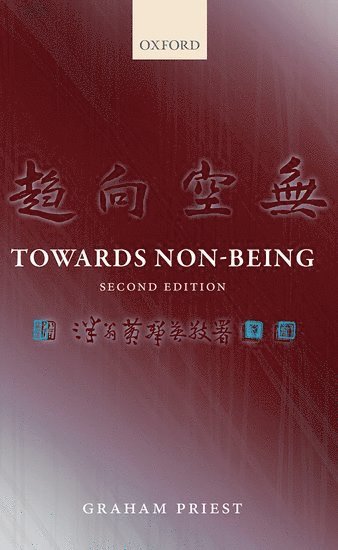
Nothing in Particular is about nothing(ness), a highly vexed notion, quickly leading to contradiction: that it is both something and nothing. Graham Priest argues that nothingness is a dialetheic object, both something and nothing-- "the paradox of nothing". Priest defines nothingness as the fusion of no things and this definition is equivalent to being the mereological complement (that is, the absence) of everything. He argues that, in virtue of not being an object, nothing is ineffable-but in a paradoxical way, since it is effable too. He also argues that, in a sense made clear in the book, nothing is the ground of reality. To be an object is to "rise above" nothing. Along the way, Nothing in Particular discusses aspects of: noneism, absences, intentionality, paradoxes of self-reference, metaphysical dependence, gluon theory, and identity and relates all these matters to the philosophies of Wang Bi (Daoism), Meister Eckhart (God), Hegel (dialectic), Sartre (freedom), Heidegger (being and nothing), and Nishida (basho and absolute nothingness). The book addresses a historically important and central area of metaphysics-nothingness-using the tools of contemporary logic and mereology, to produce a highly novel account of the subject that will be of interest to a wide range of philosophers.
Graham Priest received his doctorate from the London School of Economics. He has held chairs in philosophy in Australia, the UK, and the United States, where is currently Distinguished Professor at the CUNY Graduate Center (with visiting positions in Germany, China, and Japan). He is known for his work on logic, the philosophy of logic and mathematics, metaphysics, Buddhist philosophy, and the history of philosophy (East and West).
0: Introduction Part I. Approaching Nothing 1: Grammatical Preliminaries 2: Objects and Characterisation 3: Mereology and Absences 4: Paraconsistent Logic Part II. A Theory of Nothing 5: Nothing 6: . . . and Everything 7: The Ineffability of Nothing 8: The Ground of Reality 9: Gluon Complexities 1 10: Gluon Complexities 2 Part III. Some Philosophers of Nothing 11: Wang Bi and Meister Eckhart 12: Hegel and Sartre 13: Heidegger and Nishida 14: Concluding Nothing Epilogue: A Dialogue Appendix: Summary of Axioms, Principles, and Matrices
Nothing in Particular is about nothing(ness), a highly vexed notion, quickly leading to contradiction: that it is both something and nothing. Graham Priest argues that nothingness is a dialetheic object, both something and nothing-- "the paradox of nothing". Priest defines nothingness as the fusion of no things and this definition is equivalent to being the mereological complement (that is, the absence) of everything. He argues that, in virtue of not being an object, nothing is ineffable-but in a paradoxical way, since it is effable too. He also argues that, in a sense made clear in the book, nothing is the ground of reality. To be an object is to "rise above" nothing. Along the way, Nothing in Particular discusses aspects of: noneism, absences, intentionality, paradoxes of self-reference, metaphysical dependence, gluon theory, and identity and relates all these matters to the philosophies of Wang Bi (Daoism), Meister Eckhart (God), Hegel (dialectic), Sartre (freedom), Heidegger (being and nothing), and Nishida (basho and absolute nothingness). The book addresses a historically important and central area of metaphysics-nothingness-using the tools of contemporary logic and mereology, to produce a highly novel account of the subject that will be of interest to a wide range of philosophers.
Graham Priest received his doctorate from the London School of Economics. He has held chairs in philosophy in Australia, the UK, and the United States, where is currently Distinguished Professor at the CUNY Graduate Center (with visiting positions in Germany, China, and Japan). He is known for his work on logic, the philosophy of logic and mathematics, metaphysics, Buddhist philosophy, and the history of philosophy (East and West).
0: Introduction Part I. Approaching Nothing 1: Grammatical Preliminaries 2: Objects and Characterisation 3: Mereology and Absences 4: Paraconsistent Logic Part II. A Theory of Nothing 5: Nothing 6: . . . and Everything 7: The Ineffability of Nothing 8: The Ground of Reality 9: Gluon Complexities 1 10: Gluon Complexities 2 Part III. Some Philosophers of Nothing 11: Wang Bi and Meister Eckhart 12: Hegel and Sartre 13: Heidegger and Nishida 14: Concluding Nothing Epilogue: A Dialogue Appendix: Summary of Axioms, Principles, and Matrices