
Del i serien Disruptions
News Journalism and Twitter
Disruption, Adaption and Normalisation
Inbunden, Engelska, 2022
1 279 kr
Beställningsvara. Skickas inom 10-15 vardagar. Fri frakt för medlemmar vid köp för minst 249 kr.
Finns i fler format (1)
This book provides a critical account of the impact of Twitter on journalism, exploring how the news media has adapted to and normalised the use of the platform in the industry.Offering a comprehensive understanding of Twitter uses for journalistic purposes, this book explores the platform’s use as a ‘global village’, as an ambient news environment, and as a global marketplace. Drawing on two empirical case studies (United Kingdom and Greece), Dagoula examines academic conceptualisations of Twitter, journalists’ self-perceptions, and uses of the platform by a variety of media outlets and journalists. Adopting an evolutionary approach known as punctuated equilibrium, which consists of three stages of disruption, adaption, and normalisation, the author reveals the costs and benefits of Twitter’s impact on both the institutional values and practices of news journalism today.News Journalism and Twitter is an invaluable resource for researchers and students of digital journalism and media studies.
Produktinformation
- Utgivningsdatum2022-11-21
- Mått138 x 216 x 14 mm
- Vikt200 g
- FormatInbunden
- SpråkEngelska
- SerieDisruptions
- Antal sidor126
- FörlagTaylor & Francis Ltd
- ISBN9781032139760
Tillhör följande kategorier
Hoppa över listan

Mer från samma serie
User Comments and Moderation in Digital Journalism
Thomas B. Ksiazek, Nina Springer
Inbunden, 2020
1 279 kr
Hoppa över listan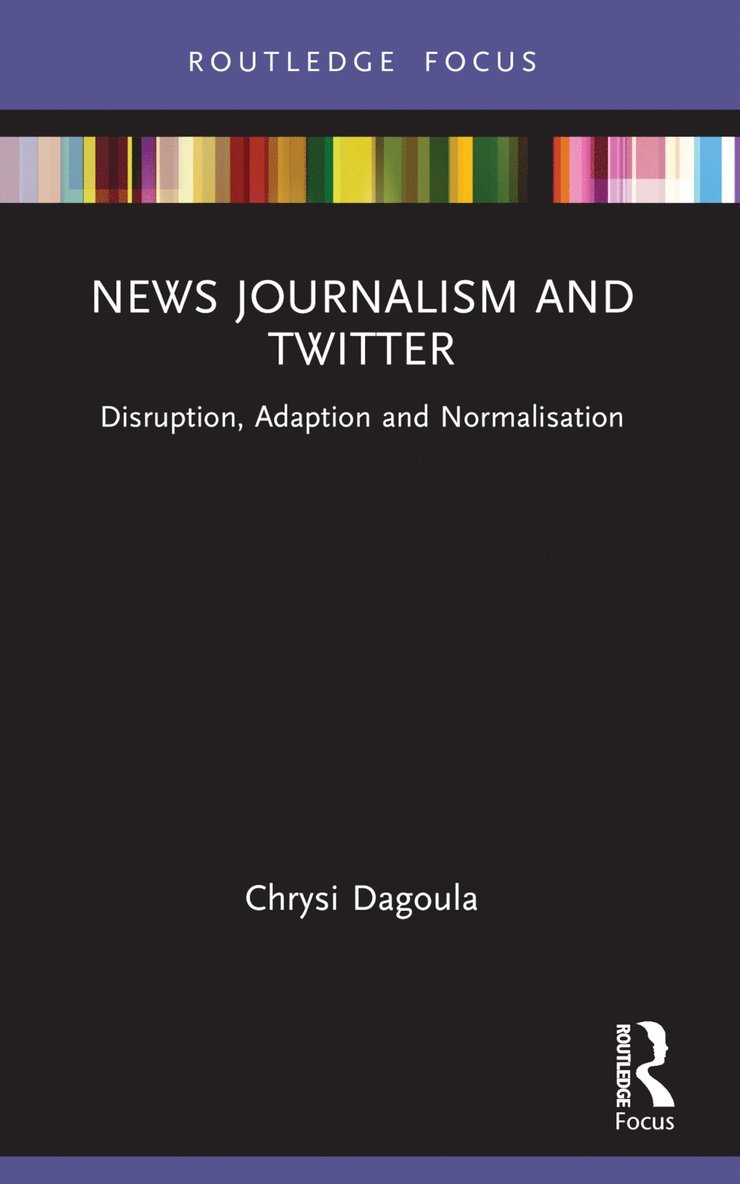







Du kanske också är intresserad av
- Nyhet
Del 3
- Nyhet
Del 11
Del 1
Del 2
- Nyhet
Del 4
- Nyhet
Del 4
- Nyhet
- Nyhet
Del 6