
Del i serien Philosophy, Technology and Society
Nanotechnology
Regulation and Public Discourse
Häftad, Engelska, 2022
659 kr
Beställningsvara. Skickas inom 10-15 vardagar. Fri frakt för medlemmar vid köp för minst 249 kr.
Over the last decades, nanoscience and nanotechnology has been ascribed the potential to contribute beneficial applications in fields such as medicine, cosmetics, or environmental remediation. At the same time it is still contested whether engineered nanomaterials might be not one-sidedly “good” but may also entail negative side-effects for human health and the environment. To address this uncertainty, academic and political initiatives have sought to establish norms and practices to assess and govern nanomaterials. Rooted in different disciplines such as ethics, ecology, law, social and political sciences, the chapters in this edited volume explore the normative approaches, societal practices, and legal mechanisms which have emerged in the nano-field over the last two decades. The chapters also present a broad variety of evaluative approaches that may assist societal actors in their attempts to actively shape and contribute to the debate about nanomaterials.
Produktinformation
- Utgivningsdatum2022-03-04
- Mått154 x 220 x 16 mm
- Vikt417 g
- FormatHäftad
- SpråkEngelska
- SeriePhilosophy, Technology and Society
- Antal sidor308
- FörlagBloomsbury Publishing Plc
- ISBN9781538147900
Tillhör följande kategorier
Hoppa över listan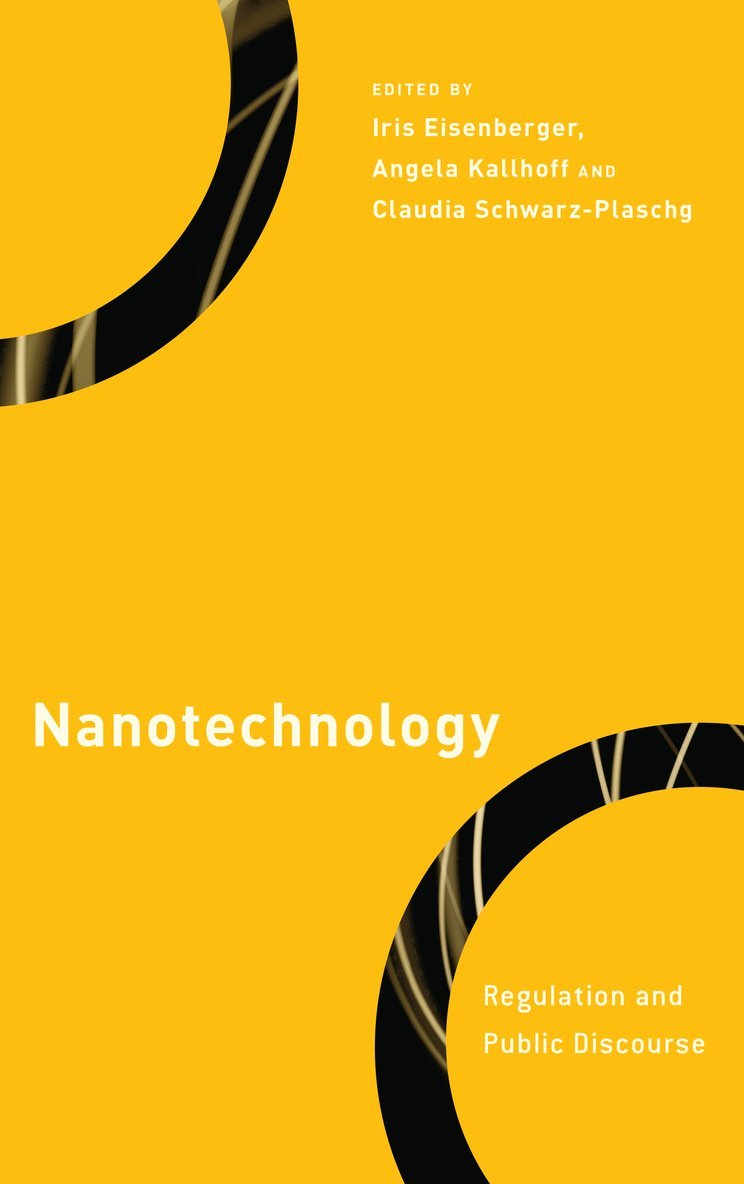









Du kanske också är intresserad av
Smart Regulation: Theorie- und evidenzbasierte Politik
Matthias Wendland, Iris Eisenberger, Rainer Niemann
Häftad, 2023
1 139 kr
Handbuch des Verwaltungsrechts 07
Jelena von Achenbach, Steffen Augsberg, Ulrich Battis, Guy Beaucamp, Peter Collin, Wolfgang Durner, Iris Eisenberger, Nikolas Eisentraut, Kurt Faßbender, Wolfgang Kahl, Markus Ludwigs
Inbunden, 2025
4 079 kr
Del 4
Ethik und die Möglichkeit einer guten Welt
Andreas Vieth, Christoph Halbig, Angela Kallhoff
Inbunden, 2008
3 409 kr
Del 36
Del 36