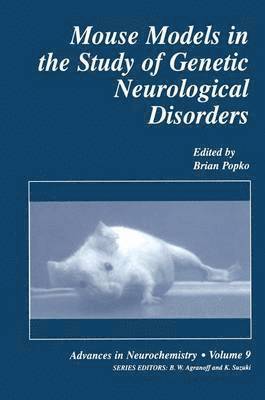
Mouse Models in the Study of Genetic Neurological Disorders
Inbunden, Engelska, 1999
2 769 kr
Beställningsvara. Skickas inom 10-15 vardagar. Fri frakt för medlemmar vid köp för minst 249 kr.
This volume covers the use of animal models for human genetic disease, including models of developmental disorders, neuromuscular diseases, neurodegenerative diseases and learning disorders. Researchers who study these disorders will find this volume a useful resource.
Produktinformation
- Utgivningsdatum1999-02-28
- Mått155 x 235 x 29 mm
- Vikt788 g
- FormatInbunden
- SpråkEngelska
- SerieAdvances in Neurochemistry
- Antal sidor366
- Upplaga1999
- FörlagSpringer Science+Business Media
- ISBN9780306459658
Tillhör följande kategorier
- 1 An Overview of Mouse Models in Neuroscience Research.- 1. Introduction.- 2. Naturally Occurring Mouse Models.- 3. Transgenic Models.- 4. Gene Targeting in Embryonic Stem Cells.- 5. Future Directions.- 6. Summary.- References.- 2 X-Linked Dysmyelination: Mouse Models of Pelizaeus—Merzbacher Disease.- 1. Pelizaeus—Merzbacher Disease and X-Linked Spastic.- Paraplegia.- 2. Myelin Proteolipid Protein (PLP/DM20).- Acknowledgments.- References.- 3 Charcot—Marie—Tooth Disease: Pathology, Genetics, and Animal Models.- 1. Introduction.- 2. Charcot—Marie—Tooth Disease.- 3. Animal Models for Charcot—Marie—Tooth Disease.- 4. Summary and Outlook.- Acknowledgments.- References.- 4 Mouse Mutations in the Study of Cerebellar Development.- 1. Cerebellar Development.- 2. Cerebellar Mouse Mutants.- 3. Conclusions.- Acknowledgments.- References.- 5 The Role of Neurotrophic Factors in Development and Neurodegenerative Disorders.- 1. Introduction.- 2. Historical Review.- 3. The NGF and GDNF Families of Neurotrophic Factors.- 4. Regulation of Specific Populations of Peripheral Neurons by Neurotrophin and GDNF Family Members.- 5. Hereditary Conditions Associated with Growth Factor Receptor Mutations.- 6. Multiple Trophic Factors Regulate the Development of Some Peripheral Neurons.- 7. Regulation of Survival of CNS Neurons.- 8. Conclusions.- References.- 6 Transgenic Mice with Neurofilament Abnormalities.- 1. Introduction.- 2. Neurofilament Structure and Function.- 3. Transgenic Mouse Models with Neurofilament Accumulations.- 4. Defective Axonal Transport in NF-H Transgenic Mice.- 5. Factors that Can Potentially Induce the Accumulation of Neurofilaments.- 6. A Link between SODI and Neurofilaments?.- 7. Prospects.- Acknowledgments.- References.- 7 Mouse Models of AmyotrophicLateral Sclerosis.- 1. SOD1 Activity and ALS.- 2. Linking Motor Neuron Growth and Death: Neurofilaments, Axonal Disorganization, and Motor Neuron Disease.- 3. Axonal Transport.- 4. Neurotrophic Factors, Bcl-2, and Apoptosis.- 5. Glutamate Excitotoxicity.- 6. Summary/Conclusions.- References.- 8 Transgenic Mouse Models of Cag Trinucleotide Repeat Neurologic Diseases.- 1. Introduction.- 2. Pathology and Neurological Alteration in Transgenic Mice with Expanded CAG Tracts.- 3. CAG Repeat Instability in Transgenic Mice.- 4. Conclusions and Closing Comments.- References.- 9 Alzheimer’s Disease and Genetically Engineered Animal Models.- 1. Introduction.- 2. Alzheimer’s Disease.- 3. Principal Risk Factors.- 4. Genetically Engineered Animal Models.- 5. Conclusions.- Acknowledgments.- References.- 10 Model of Genetic Susceptibility to Late-Onset Alzheimer’s Disease: Mice Transgenic for Human Apolipoprotein E Alleles.- 1. Genetic Classification of AD.- 2. APOE Susceptibility Gene for AD.- 3. APOE in the Periphery.- 4. APOE in the Central Nervous System.- 5. APOE in the Peripheral Nervous System.- 6. APOE and Pathogenesis of AD—Extracellular Role.- 7. APOE and Pathogenesis of AD—Intracellular Role.- 8. Human Pattern of Neuronal and Glial Localization of APOE.- 9. Apolipoprotein E and Oxidative Injury.- 10. Genetic Models of APOE as a Susceptibility Gene in AD.- 11. APOE Gene Inactivation Model.- 12. Consideration of Genetic Background in Analysis of APOE “Knockouts” and Transgenes.- 13. APOE Transgenic Model with Human Regulatory Sequences.- 14. APOE Transgenic Model with Nonhuman Regulatory Sequences.- 15. APOE Targeted Replacement Animals.- 16. Current Models for the Effect of APOE Alleles on Susceptibility to AD.- 17. Summary/Conclusions.- Acknowledgments.-References.- 11 Lysosomal Disorders.- 1. Introduction.- 2. Naturally Occurring Mouse Models.- 3. Artificially Generated Mouse Models.- 4. Utility of Experimental Animal Models.- 5. On the Horizon.- Acknowledgments.- References.- 12 Neurological Implications of the Genetic Mouse Models for Human Phenylketonuria and Hyperphenylalaninemia.- 1. Introduction.- 2. Earlier Efforts to Produce Mouse PKU Models.- 3. The Genetic PKU Mouse Program.- 4. Future Studies Enabled by the Genetic Mouse Model for.- Human PKU.- References.- 13 Mouse Models of Down Syndrome.- 1. Introduction.- 2. Location of Human Chromosome 21 Genes in the Mouse Genome.- 3. History of Mouse Trisomy Models for DS.- 4. Mental Retardation and Neurological Deficits.- 5. Summary.- Acknowledgments.- References.- 14 Modeling Epileptic Disorders in Mice.- 1. Introduction.- 2. Monogenic Epilepsy Models in Mice.- 3. Multifactorial Epilepsy Models in Mice.- 4. Genetic Models of Spontaneous Lethal Epilepsies and Status Epilepticus.- 5. Mapping Epilepsy Genes in the Human and the Mouse.- Acknowledgments.- References.