
Del i serien Microsystems
Micromachined Mirrors
Inbunden, Engelska, 2002
1 439 kr
Beställningsvara. Skickas inom 10-15 vardagar. Fri frakt för medlemmar vid köp för minst 249 kr.
Finns i fler format (1)
Micromachined scanning mirrors are interesting for a wide variety of applications because of their potential low cost, high speed, low power consumption, and reliability. These mirrors can offer significant advantages over macro-scale mirrors, but their fundamental limitations have not been widely discussed. Miniaturization in electronic systems has led to radical improvements in computers and communications, and micromachining technologies promise to generate such improvements in miniaturized mechanical and optical systems, including specifically higher-speed, smaller, lower-cost scanning mirrors. This text provides an overview of the performance enhancements that will be realized by miniaturizing scanning mirrors like those used for laser printers and barcode scanners, and the newly enabled applications, including raster-scanning projection video displays and compact, high-speed fiber-optic components. There are a wide variety of methods used to fabricate micromachined mirrors - each with its advantages and disadvantages. There are, however, performance criteria common to mirrors made from any of these fabrication processes.For example, optical resolution is related to the mirror aperture, the mirror flatness, and the scan angle. This book provides a framework for the design of micromirrors, and derives equations showing the fundamental limits for micromirror performance. These limits provide the micromirror designer tools with which to determine the acceptable mirror geometries, and to quickly and easily determine the range of possible mirror optical resolution and scan speed. The book presents descriptions of mirrors made from two fabrication processes - the surface-micromachining process and the staggered torsional electrostatic combdrive (STEC) high-aspect ratio micromachining process. The mirrors made using these two processes are evaluated for scan speed, optical resolution, ease of manufacture, and reliability. "Micromachined Mirrors" also presents an example application of surface-micromachined mirrors: a raster-scanning projection video display. This demonstration shows the advantages of micromachined mirrors (small high-speed scanners) with special attention paid to the major drawback of surface-micromachined mirrors (lower resolution due to dynamic deformation).The successful demonstration of this simple prototype video display helps clarify the importance of the critical performance characteristics to consider when designing micromachined mirrors.
Produktinformation
- Utgivningsdatum2002-12-31
- Mått155 x 235 x 15 mm
- Vikt410 g
- FormatInbunden
- SpråkEngelska
- SerieMicrosystems
- Antal sidor139
- Upplaga2003
- FörlagKluwer Academic Publishers
- ISBN9781402073120
Tillhör följande kategorier
Hoppa över listan



Mer från samma serie
Del 17
Del 7
Scanning Probe Lithography
Hyongsok T. Soh, Kathryn Wilder Guarini, Calvin F. Quate
Inbunden, 2001
1 439 kr
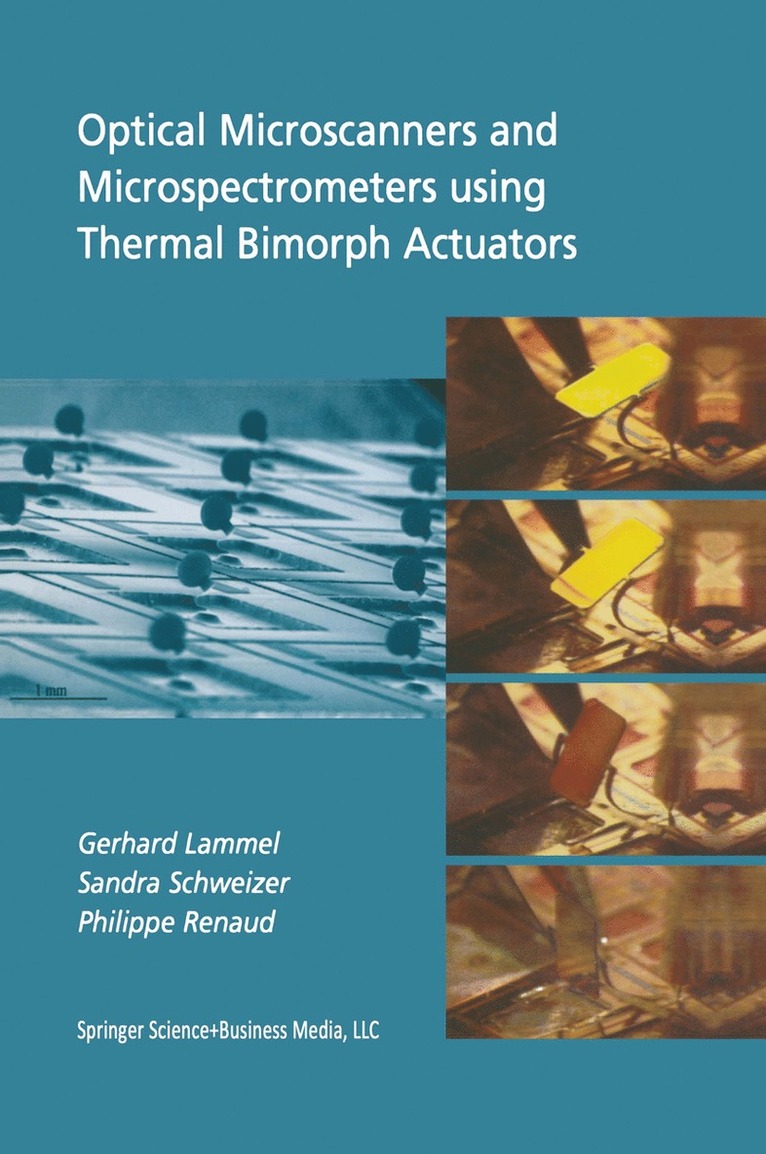
Optical Microscanners and Microspectrometers using Thermal Bimorph Actuators
Gerhard Lammel, Sandra Schweizer, Philippe Renaud
Inbunden, 2002
2 149 kr
Del 2
Methodology for the Modeling and Simulation of Microsystems
Bartlomiej F. Romanowicz
Inbunden, 1998
1 439 kr
Del 1
Del 3
Bringing Scanning Probe Microscopy up to Speed
Stephen C. Minne, Scott R. Manalis, Calvin F. Quate
Inbunden, 1999
1 439 kr
Micromachined Ultrasound-Based Proximity Sensors
Mark R. Hornung, Oliver Brand, Mark R. Hornung, Oliver Brand
Inbunden, 1999
1 439 kr
Del 5
Microfabrication in Tissue Engineering and Bioartificial Organs
Sangeeta N. Bhatia
Inbunden, 1999
1 479 kr
Hoppa över listan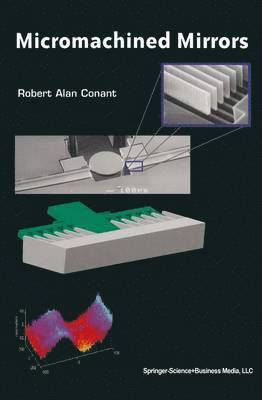



Du kanske också är intresserad av
Del 13
Optical Microscanners and Microspectrometers using Thermal Bimorph Actuators
Gerhard Lammel, Sandra Schweizer, Philippe Renaud
Inbunden, 2002
2 149 kr
- Nyhet
Del 3
Micromachined Ultrasound-Based Proximity Sensors
Mark R. Hornung, Oliver Brand, Mark R. Hornung, Oliver Brand
Inbunden, 1999
1 439 kr
Del 3
Bringing Scanning Probe Microscopy up to Speed
Stephen C. Minne, Scott R. Manalis, Calvin F. Quate
Inbunden, 1999
1 439 kr
- Nyhet
Del 11
Del 5
Microfabrication in Tissue Engineering and Bioartificial Organs
Sangeeta N. Bhatia
Inbunden, 1999
1 479 kr