
Del i serien Kuroda Studies in East Asian Buddhism
Making of a Savior Bodhisattva
Dizang in Medieval China
Häftad, Engelska, 2016
279 kr
Beställningsvara. Skickas inom 5-8 vardagar. Fri frakt för medlemmar vid köp för minst 249 kr.
In modern Chinese Buddhism, Dizang is especially popular as the sovereign of the underworld. Often represented as a monk wearing a royal crown, Dizang helps the deceased faithful navigate the complex underworld bureaucracy, avert the punitive terrors of hell, and arrive at the happy realm of rebirth. The author is concerned with the formative period of this important Buddhist deity, before his underworldly aspect eclipses his connections to other religious expressions and at a time when the art, mythology, practices, and texts of his cult were still replete with possibilities. She begins by problematizing the reigning model of Dizang, one that proposes an evolution of gradual sinicization and increasing vulgarization of a relatively unknown Indian bodhisattva, Ksitigarbha, into a Chinese deity of the underworld. Such a model, the author argues, obscures the many-faceted personality and iconography of Dizang. Rejecting it, she deploys a broad array of materials (art, epigraphy, ritual texts, scripture, and narrative literature) to recomplexify Dizang and restore (as much as possible from the fragmented historical sources) what this figure meant to Chinese Buddhists from the sixth to tenth centuries.Rather than privilege any one genre of evidence, the author treats both material artifacts and literary works, canonical and noncanonical sources. Adopting an archaeological approach, she excavates motifs from and finds resonances across disparate genres to paint a vibrant, detailed picture of the medieval Dizang cult. Through her analysis, the cult, far from being an isolated phenomenon, is revealed as integrally woven into the entire fabric of Chinese Buddhism, functioning as a kaleidoscopic lens encompassing a multivalent religio-cultural assimilation that resists the usual bifurcation of doctrine and practice or ""elite"" and ""popular"" religion.The Making of a Savior Bodhisattva presents a fascinating wealth of material on the personality, iconography, and lore associated with the medieval Dizang. It elucidates the complex cultural, religious, and social forces shaping the florescence of this savior cult in Tang China while simultaneously addressing several broader theoretical issues that have preoccupied the field. Zhiru not only questions the use of sinicization as a lens through which to view Chinese Buddhist history, she also brings both canonical and noncanonical literature into dialogue with a body of archaeological remains that has been ignored in the study of East Asian Buddhism.
Produktinformation
- Utgivningsdatum2016-11-30
- Mått149 x 226 x 22 mm
- Vikt471 g
- FormatHäftad
- SpråkEngelska
- SerieKuroda Studies in East Asian Buddhism
- Antal sidor328
- FörlagUniversity of Hawai'i Press
- ISBN9780824867584
Tillhör följande kategorier
Hoppa över listan


Mer från samma serie
Right Thoughts at the Last Moment
Jacqueline I. Stone, Robert E. Buswell, Robert E Buswell
Inbunden, 2016
299 kr
Hoppa över listan

Du kanske också är intresserad av
Hokkeji and the Reemergence of Female Monastic Orders in Premodern Japan
Lori R. Meeks
Häftad, 2022
279 kr
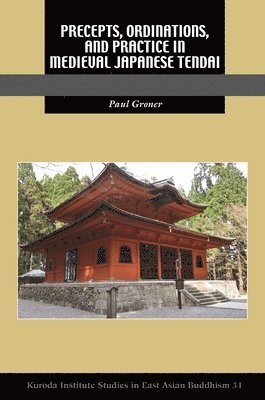
Precepts, Ordinations, and Practice in Medieval Japanese Tendai
Paul Groner, Robert E. Buswell, Robert E Buswell
Inbunden, 2022
1 009 kr
Right Thoughts at the Last Moment
Jacqueline I. Stone, Robert E. Buswell, Robert E Buswell
Inbunden, 2016
299 kr