
Lost Italian Renaissance
Humanists, Historians, and Latin's Legacy
Häftad, Engelska, 2006
579 kr
Beställningsvara. Skickas inom 5-8 vardagar. Fri frakt för medlemmar vid köp för minst 249 kr.
The intellectual heritage of the Italian Renaissance rivals that of any period in human history. Yet even as the social, political, and economic history of Renaissance Italy inspires exciting and innovative scholarship, the study of its intellectual history has grown less appealing, and our understanding of its substance and significance remains largely defined by the work of nineteenth-century thinkers. In The Lost Italian Renaissance, historian and literary scholar Christopher Celenza argues that serious interest in the intellectual life of Renaissance Italy can be reinvigorated-and the nature of the Renaissance itself reconceived-by recovering a major part of its intellectual and cultural activity that has been largely ignored since the Renaissance was first "discovered": the vast body of works-literary, philosophical, poetic, and religious-written in Latin.Produced between the mid-fourteenth and the early sixteenth centuries by major figures such as Leonardo Bruni, Lorenzo Valla, Marsilio Ficino, and Leon Battista Alberti, as well as minor but interesting thinkers like Lapo da Castiglionchio the Younger, this literature was initially overlooked by scholars of the Renaissance because they were not written in the vernacular Italian which alone was seen as was the supreme expression of a culture. This lack of attention, which continued well into the twentieth century, has led interpreters to misread key aspects of the Renaissance. Offering a flexible theoretical framework within which to understand these Latin texts, Celenza explains why these "lost" sources are distinctive and why they are worthy of study. What will we really find among the Latin texts of the Renaissance? First, Celenza contends, there are a limited number of intellectuals who deserve a place in any canon of the period, and without whom our literary and philosophical heritage is diminished. Second, and more commonly, this literature establishes the intellectual traditions from which such well-known vernacular writers as Machiavelli and Castiglione emerge.And third, these Latin texts may contain strands of intellectual life that have been lost altogether. A groundbreaking work of intellectual history, The Lost Italian Renaissance uncovers a priceless intellectual legacy suggests provocative new avenues of research.
Produktinformation
- Utgivningsdatum2006-03-06
- Mått152 x 229 x 15 mm
- Vikt318 g
- FormatHäftad
- SpråkEngelska
- Antal sidor232
- FörlagJohns Hopkins University Press
- ISBN9780801883842
- UtmärkelserWinner of Renaissance Society of America Phyllis Goodhart Gordan Book Prize 2005 (United States)
Tillhör följande kategorier
Hoppa över listan

Mer från samma författare
The Evolution of Western Thought: Volume 1, From the Ancient World to Late Antiquity
Christopher S. Celenza
Inbunden, 2026
619 kr
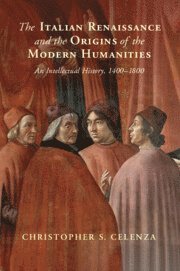
The Italian Renaissance and the Origins of the Modern Humanities
Christopher S. Celenza
Inbunden, 2021
889 kr
The Italian Renaissance and the Origins of the Modern Humanities
Christopher S. Celenza
Häftad, 2023
659 kr
Del 6
Del 172
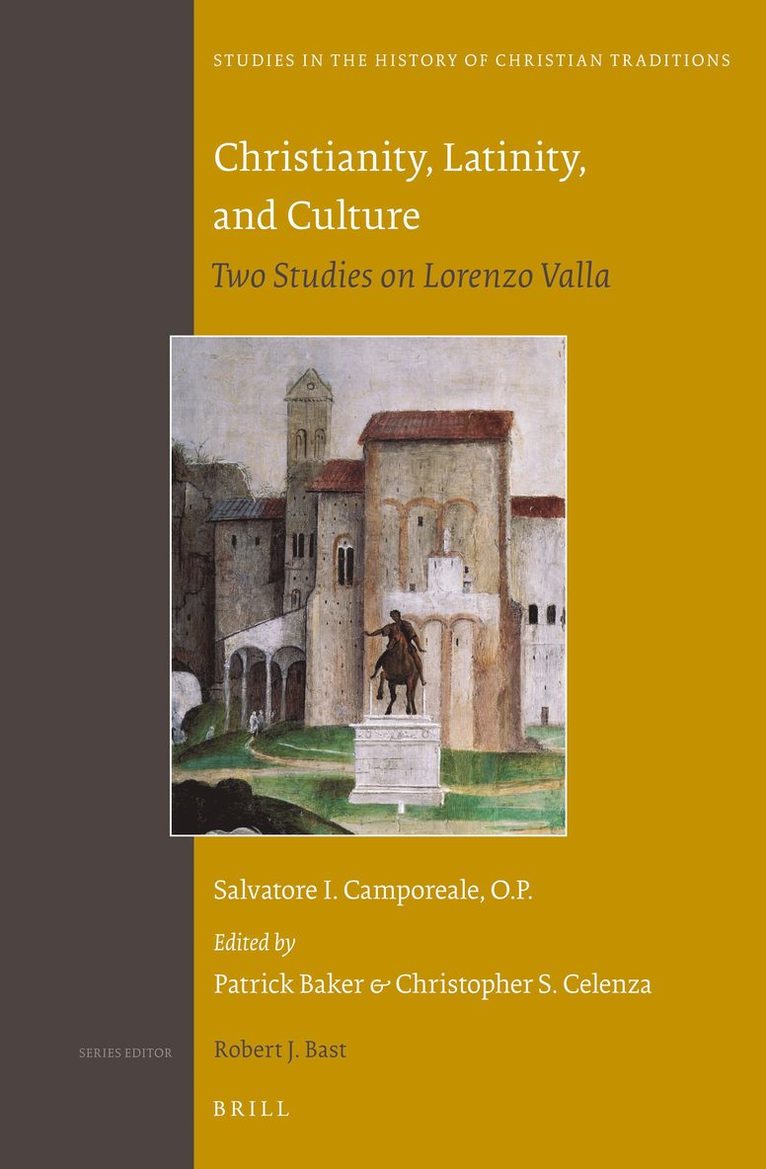
Christianity, Latinity, and Culture
Salvatore I. Camporeale, Patrick Baker, Christopher S. Celenza
Inbunden, 2013
4 249 kr
Hoppa över listan

Du kanske också är intresserad av
The Italian Renaissance and the Origins of the Modern Humanities
Christopher S. Celenza
Häftad, 2023
659 kr
Del 6
The Evolution of Western Thought: Volume 1, From the Ancient World to Late Antiquity
Christopher S. Celenza
Inbunden, 2026
619 kr
The Italian Renaissance and the Origins of the Modern Humanities
Christopher S. Celenza
Inbunden, 2021
889 kr
Del 172
Christianity, Latinity, and Culture
Salvatore I. Camporeale, Patrick Baker, Christopher S. Celenza
Inbunden, 2013
4 249 kr
- Nyhet
- Nyhet