
Liberty, Conscience, and Toleration
The Political Thought of William Penn
Häftad, Engelska, 2018
519 kr
Beställningsvara. Skickas inom 5-8 vardagar. Fri frakt för medlemmar vid köp för minst 249 kr.
Finns i fler format (1)
In a seventeenth-century English landscape populated with towering political and philosophical figures like Hobbes, Harrington, Cromwell, Milton, and Locke, William Penn remains in many ways a man apart. Yet despite being widely neglected by scholars, he was a sophisticated political thinker who contributed mightily to the theory and practice of religious liberty in the early modern Atlantic world. In this long-awaited intellectual biography of William Penn, Andrew R. Murphy presents a nuanced portrait of this remarkable entrepreneur, philosopher, Quaker, and politician.Liberty, Conscience, and Toleration focuses on the major political episodes that attracted William Penn's sustained attention as a political thinker and actor: the controversy over the Second Conventicle Act, the Popish Plot and Exclusion Crisis, the founding and settlement of Pennsylvania, and the contentious reign of James II. Through a careful examination of writings published in the midst of the religious and political conflicts of Restoration and Revolutionary England, Murphy contextualizes the development of Penn's thought in England and America, illuminating the mutual interconnections between Penn's political thought and his colonizing venture in America. An early advocate of representative institutions and religious freedom, William Penn remains a singular figure in the history of liberty of conscience. His political theorizing provides a window into the increasingly vocal, organized, and philosophically sophisticated tolerationist movement that gained strength over the second half of the seventeenth century. Not only did Penn attempt to articulate principles of religious liberty as a Quaker in England, but he actually governed an American polity and experienced firsthand the complex relationship between political theory and political practice. Murphy's insightful analysis shows Penn's ongoing significance to the broader study of Anglo-American political and practice, ultimately pointing scholars toward a new way of understanding the enterprise of political theory itself.
Produktinformation
- Utgivningsdatum2018-12-21
- Mått155 x 234 x 15 mm
- Vikt476 g
- FormatHäftad
- SpråkEngelska
- Antal sidor320
- FörlagOUP USA
- ISBN9780190935894
Tillhör följande kategorier
Hoppa över listan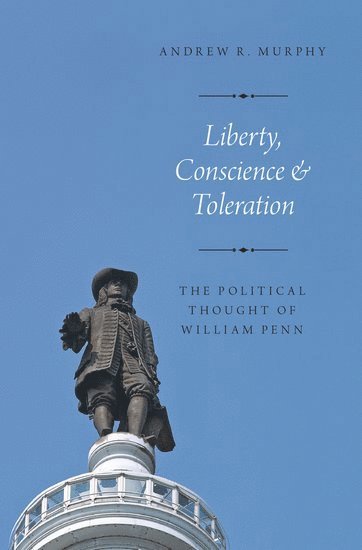



Du kanske också är intresserad av
Dying for the Dawn
Marisol Lopez-Menendez, Fortunato Mallimaci, Oscar A. Castro Soto, Amilcar Carpio, Julia Young, Kristina Boylan, Andrew R. Murphy, María del Carmen Moreno-Cardenas, Paula Tesche, Yves Solis, Prepa Ibero, Boris Hau, Iliana Moreno Téllez, Gregory Swedberg, Paula Tesche Roa, Loreto Chandia Jara, Gabriel Figueroa Montero, Eduardo Gusmao de Quadros, Marisol Lopez-Menendez
Inbunden, 2026
1 989 kr
Del 24
Del 42
Blackwell Companion to Religion and Violence
Andrew R. Murphy, Andrew R. Murphy
Inbunden, 2011
2 789 kr