
Del 36 i serien Studies in Platonism, Neoplatonism, and the Platonic Tradition
L’Esthétique néoplatonicienne: de Plotin à Marsile Ficin
Inbunden, Franska, 2026
3 239 kr
Beställningsvara. Skickas inom 5-8 vardagar. Fri frakt för medlemmar vid köp för minst 249 kr.
La Beauté plotinienne, simple comme l'éclair, non symétrique, devenue intelligible, âme et idée, transcendante comme le Bien, c'était Ulysse, et non Narcisse. Dans l'Ennéade 31, elle est reliée à l’Art, l'Intelligence, et la Sagesse, gravée dans les temples. Augustin aimait les Beautés, et a lu l'Hortensius. À Milan, écrit à Cassiciacum, épris de Plotin, il devient chrétien, sous Ambroise. La mystique de Ps-Denys, des ténèbres à la lumière influencera le Moyen Âge, et la Hiérarchie Céleste commentée par Scot Érigène et Hugues de Saint-Victor inspirera à Suger la basilique gothique. Ficin, (quinzième siècle), le nouvel Orphée, promouvra cette Esthétique de la lumière, reprendra Plotin, et expliquera à Lorenzo le Printemps.The Beauty of Plotinus, simple as lightning, asymmetrical, intelligible, soul and idea, transcendent like Good, was Ulysses, not Narcissus. In the Ennead 31, it is linked to Art, Intelligence, and Wisdom, and engraved in temples. Later, Saint Augustine too loved Beauty and read the Hortensius. In Milan, whilst in Cassiciacum and enamoured with Plotinus, Saint Augustine converted to Christianity under Ambrose. The mysticism of Pseudo-Dionysius, from darkness to light, then influenced the Middle Ages, and his Celestial Hierarchy, commented on by Scotus Eriugena and Hugh of Saint Victor, would inspire Suger's writings on light, the divine and Gothic architecture. At last, Ficino (15th century), the new Orpheus, promoted Suger's Aesthetics of Light, studied Plotinus, and explained to Lorenzo de' Medici the painting Primavera.
Produktinformation
- Utgivningsdatum2026-07-16
- Mått155 x 235 x 28 mm
- Vikt709 g
- FormatInbunden
- SpråkFranska
- SerieStudies in Platonism, Neoplatonism, and the Platonic Tradition
- Antal sidor334
- FörlagBrill
- ISBN9789004756380
Tillhör följande kategorier
Hoppa över listan
Mer från samma serie
Del 7
Del 8
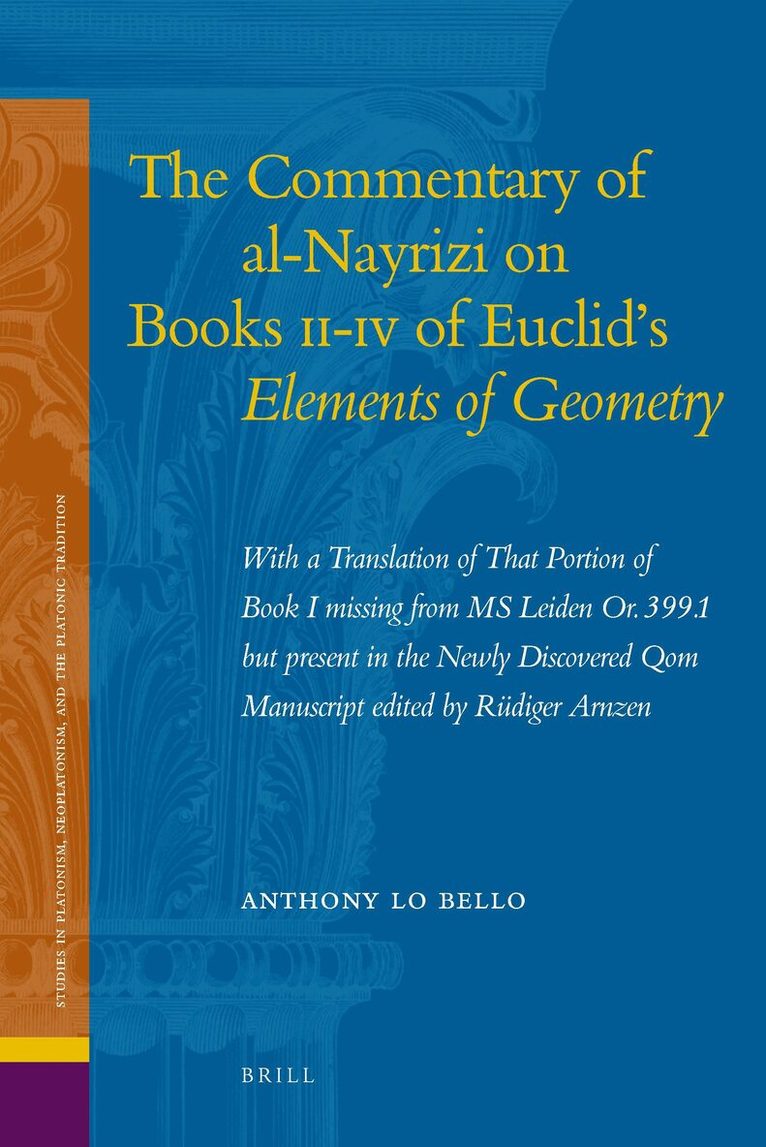
Commentary of al-Nayrizi on Books II-IV of Euclid's Elements of Geometry
Anthony Lo Bello
Inbunden, 2009
2 929 kr
Del 9
Del 13
Del 10
Del 11
Del 12
Del 15
Studies on Plato, Aristotle and Proclus
John J. Cleary, John M. Dillon, Brendan O'Byrne, Fran O'Rourke
Inbunden, 2013
5 939 kr
Del 14
Del 16
Hoppa över listan



Du kanske också är intresserad av
Del 28
Del 32
Del 33
Del 16
- Nyhet
Del 3
Del 13
Del 10
- Nyhet
Del 11
Del 11