
Del i serien Routledge Innovations in Political Theory
Kantian Theory and Human Rights
Inbunden, Engelska, 2013
3 219 kr
Beställningsvara. Skickas inom 10-15 vardagar. Fri frakt för medlemmar vid köp för minst 249 kr.
Human rights and the courts and tribunals that protect them are increasingly part of our moral, legal, and political circumstances. The growing salience of human rights has recently brought the question of their philosophical foundation to the foreground. Theorists of human rights often assume that their ideal can be traced to the philosophy of Immanuel Kant and his view of humans as ends in themselves. Yet, few have attempted to explore exactly how human rights should be understood in a Kantian framework. The scholars in this book have gathered to fill this gap. At the center of Kant’s theory of rights is a view of freedom as independence from domination. The chapters explore the significance of this theory for the nature of human rights, their justification, and the legitimacy of international human rights courts.
Produktinformation
- Utgivningsdatum2013-12-05
- Mått156 x 234 x 18 mm
- Vikt590 g
- FormatInbunden
- SpråkEngelska
- SerieRoutledge Innovations in Political Theory
- Antal sidor210
- FörlagTaylor & Francis Ltd
- ISBN9780415857697
Tillhör följande kategorier
Hoppa över listan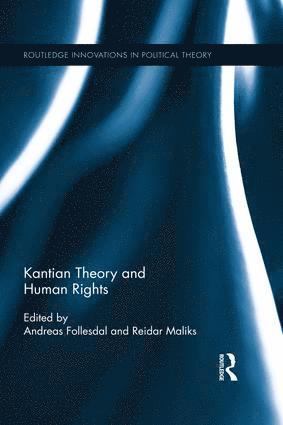



Du kanske också är intresserad av
Moral and Political Conceptions of Human Rights
Reidar Maliks, Johan Karlsson Schaffer
Häftad, 2018
699 kr
The Performance of International Courts and Tribunals
Theresa Squatrito, Oran R. Young, Andreas Follesdal, Geir Ulfstein
Inbunden, 2018
2 589 kr
Kant’s Early Followers in Political Philosophy
Reidar Maliks, Elisabeth Theresia Widmer
Inbunden, 2025
3 219 kr
Moral and Political Conceptions of Human Rights
Reidar Maliks, Johan Karlsson Schaffer
Inbunden, 2017
2 049 kr