
Intellectual Life of Edmund Burke
From the Sublime and Beautiful to American Independence
Inbunden, Engelska, 2014
569 kr
Beställningsvara. Skickas inom 10-15 vardagar. Fri frakt för medlemmar vid köp för minst 249 kr.
David Bromwich’s portrait of statesman Edmund Burke (1730–1797) is the first biography to attend to the complexity of Burke’s thought as it emerges in both the major writings and private correspondence. The public and private writings cannot be easily dissociated, nor should they be. For Burke—a thinker, writer, and politician—the principles of politics were merely those of morality enlarged. Bromwich reads Burke’s career as an imperfect attempt to organize an honorable life in the dense medium he knew politics to be.This intellectual biography examines the first three decades of Burke’s professional life. His protest against the cruelties of English society and his criticism of all unchecked power laid the groundwork for his later attacks on abuses of government in India, Ireland, and France. Bromwich allows us to see the youthful skeptic, wary of a social contract based on “nature”; the theorist of love and fear in relation to “the sublime and beautiful”; the advocate of civil liberty, even in the face of civil disorder; the architect of economic reform; and the agitator for peace with America. However multiple and various Burke’s campaigns, a single-mindedness of commitment always drove him.Burke is commonly seen as the father of modern conservatism. Bromwich reveals the matter to be far more subtle and interesting. Burke was a defender of the rights of disfranchised minorities and an opponent of militarism. His politics diverge from those of any modern party, but all parties would be wiser for acquaintance with his writing and thoughts.
Produktinformation
- Utgivningsdatum2014-05-06
- Mått156 x 235 x 40 mm
- Vikt868 g
- FormatInbunden
- SpråkEngelska
- Antal sidor512
- FörlagHarvard University Press
- ISBN9780674729704
- UtmärkelserNominated for Pulitzer Prizes 2015
Tillhör följande kategorier
Hoppa över listan
Mer från samma författare
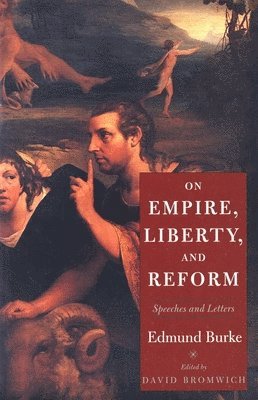
On Empire, Liberty, and Reform: Speeches and Letters
Edmund Burke, David Bromwich
Häftad, 2000
1 629 kr
Hoppa över listan
Du kanske också är intresserad av
Selected Writings of William Hazlitt Vol 9
Duncan Wu, Tom Paulin, David Bromwich, Stanley Jones, Roy Park
Inbunden, 1998
3 139 kr
Selected Writings of William Hazlitt Vol 4
Duncan Wu, Tom Paulin, David Bromwich, Stanley Jones, Roy Park
Inbunden, 1998
3 139 kr
Selected Writings of William Hazlitt Vol 7
Duncan Wu, Tom Paulin, David Bromwich, Stanley Jones, Roy Park
Inbunden, 1998
3 139 kr
On Empire, Liberty, and Reform: Speeches and Letters
Edmund Burke, David Bromwich
Häftad, 2000
1 629 kr