
Del i serien Modern Inorganic Chemistry
Inorganometallic Chemistry
Häftad, Engelska, 2013
2 139 kr
Beställningsvara. Skickas inom 10-15 vardagar. Fri frakt för medlemmar vid köp för minst 249 kr.
There is a certain fascination associated with words. The manipulation of strings of symbols according to mutually accepted rules allows a language to express history as well as to formulate challenges for the future. But language changes as old words are used in a new context and new words are created to describe changing situations. How many words has the computer revolution alone added to languages? "Inorganometallic" is a word you probably have never encountered before. It is one created from old words to express a new presence. A strange sounding word, it is also a term fraught with internal contradiction caused by the accepted meanings of its constituent parts. "In organic" is the name of a discipline of chemistry while "metallic" refers to a set of elements constituting a subsection of that discipline. Why then this Carrollian approach to entitling a set of serious academic papers? Organic, the acknowledged doyenne of chemistry, is distinguished from her brother, inorganic, by the prefix "in," i. e. , he gets everything not organic. Organometallic refers to compounds with carbon-metal bonds. It is simple! Inorganometallic is everything else, i. e. , compounds with noncarbon-metal element bonds. But why a new term? Is not inorganic sufficient? By virtue of training, limited time, resources, co-workers, and so on, chemists tend to work on a specific element class, on a particular compound type, or in a particular phase. Thus, one finds element-oriented chemists (e. g.
Produktinformation
- Utgivningsdatum2013-06-19
- Mått155 x 235 x 23 mm
- Vikt628 g
- FormatHäftad
- SpråkEngelska
- SerieModern Inorganic Chemistry
- Antal sidor401
- FörlagSpringer-Verlag New York Inc.
- ISBN9781489924612
Tillhör följande kategorier
Hoppa över listan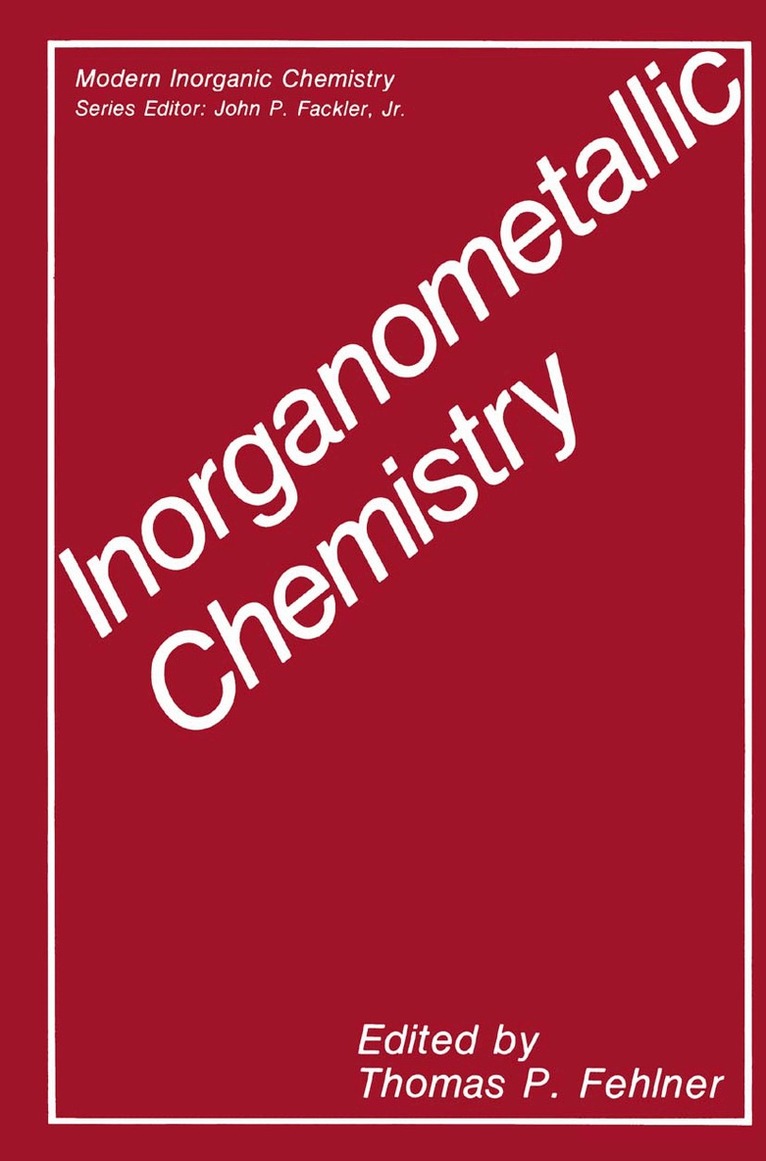
Du kanske också är intresserad av
Optoelectronic Properties of Inorganic Compounds
D. Max Roundhill, John P. Fackler Jr.
Häftad, 2010
2 139 kr
Del 2
Mössbauer Spectroscopy Applied to Magnetism and Materials Science
Gary J. Long, Charles 1947- Long, G.J Long, F. Grandjean
Inbunden, 1996
2 139 kr
Computational Methods for the Determination of Formation Constants
David J. Leggett
Häftad, 2012
719 kr