
Del i serien T&T Clark Studies in Systematic Theology
God's Being Towards Fellowship
Schleiermacher, Barth, and the Meaning of ‘God is Love’
Häftad, Engelska, 2020
629 kr
Beställningsvara. Skickas inom 10-15 vardagar. Fri frakt för medlemmar vid köp för minst 249 kr.
Finns i fler format (1)
Justin Stratis explores the meaning of the biblical phrase ‘God is love’ through an examination of two quintessentially modern Protestant theologians: Friedrich Schleiermacher and Karl Barth. This book contains both a detailed engagement with Schleiermacher’s untranslated lectures on Dialektik and their relation to his more well-known work, as well as a new assessment of Barth’s doctrine of God which both respects his radical innovations and yet places him within the stream of traditional, catholic trinitarianism.After considering the complexities of theological predication, and comparing several classical and contemporary approaches to the implication of ‘love’, Stratis presents and ultimately commends the distinct approaches of Schleiermacher and Barth for their tendency to treat divine love as a ‘conclusion’ to the doctrine of God, rather than as a conceptual starting point. In contrast to many contemporary approaches, Stratis concludes with the suggestion that God’s love is best conceived as his being toward fellowship, rather than as the eminent instance of loving fellowship understood according to human experiences of love.
Produktinformation
- Utgivningsdatum2020-11-26
- Mått156 x 234 x 11 mm
- Vikt299 g
- FormatHäftad
- SpråkEngelska
- SerieT&T Clark Studies in Systematic Theology
- Antal sidor208
- FörlagBloomsbury Publishing PLC
- ISBN9780567698186
Tillhör följande kategorier
Hoppa över listan





Mer från samma serie
Kenotic Trajectory of the Church in Donald MacKinnon's Theology
Timothy G. Connor, Ian a. McFarland
Inbunden, 2011
2 719 kr
Hoppa över listan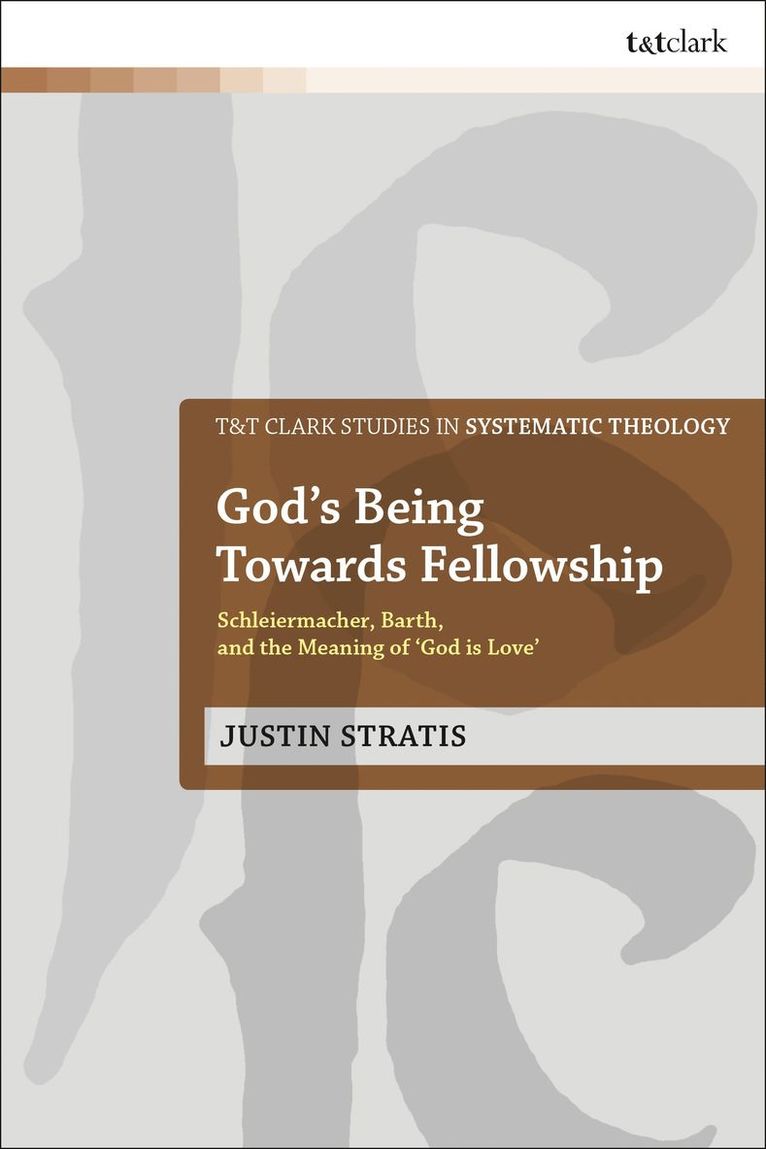







Du kanske också är intresserad av
- Nyhet
Del 3
- Nyhet
Del 11
- Nyhet
Del 4
Del 3
- Nyhet
Del 6
Del 1