
Del 52
Del i serien Studies in History and Philosophy of Science
From Discrete to Continuous
The Broadening of Number Concepts in Early Modern England
Häftad, Engelska, 2010
1 479 kr
Beställningsvara. Skickas inom 10-15 vardagar. Fri frakt för medlemmar vid köp för minst 249 kr.
Finns i fler format (1)
In the early modern period, a crucial transformation occurred in the classical conception of number and magnitude. Traditionally, numbers were merely collections of discrete units that measured some multiple. Magnitude, on the other hand, was usually described as being continuous, or being divisible into parts that are infinitely divisible. This traditional idea of discrete number versus continuous magnitude was challenged in the early modern period in several ways.This detailed study explores how the development of algebraic symbolism, logarithms, and the growing practical demands for an expanded number concept all contributed to a broadening of the number concept in early modern England. An interest in solving practical problems was not, in itself, enough to cause a generalisation of the number concept. It was the combined impact of novel practical applications together with the concomitant development of such mathematical advances as algebraic notation and logarithms that produced a broadened number concept.
Produktinformation
- Utgivningsdatum2010-12-06
- Mått155 x 235 x 11 mm
- Vikt295 g
- FormatHäftad
- SpråkEngelska
- SerieStudies in History and Philosophy of Science
- Antal sidor175
- FörlagSpringer
- ISBN9789048159932
Tillhör följande kategorier
Hoppa över listan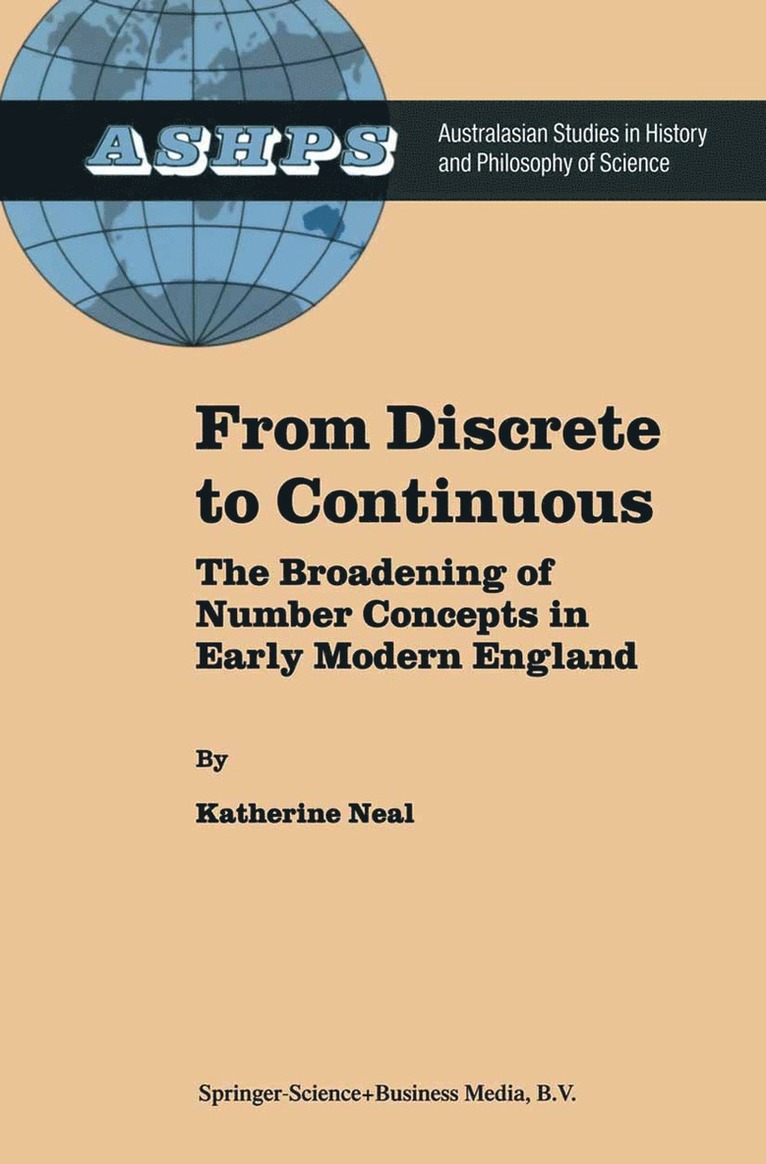







Du kanske också är intresserad av
- Nyhet
Del 3
- Nyhet
Del 11
- Nyhet
Del 6
- Nyhet
Del 4
Del 3
Del 1
Del 2
Del 7
- Nyhet