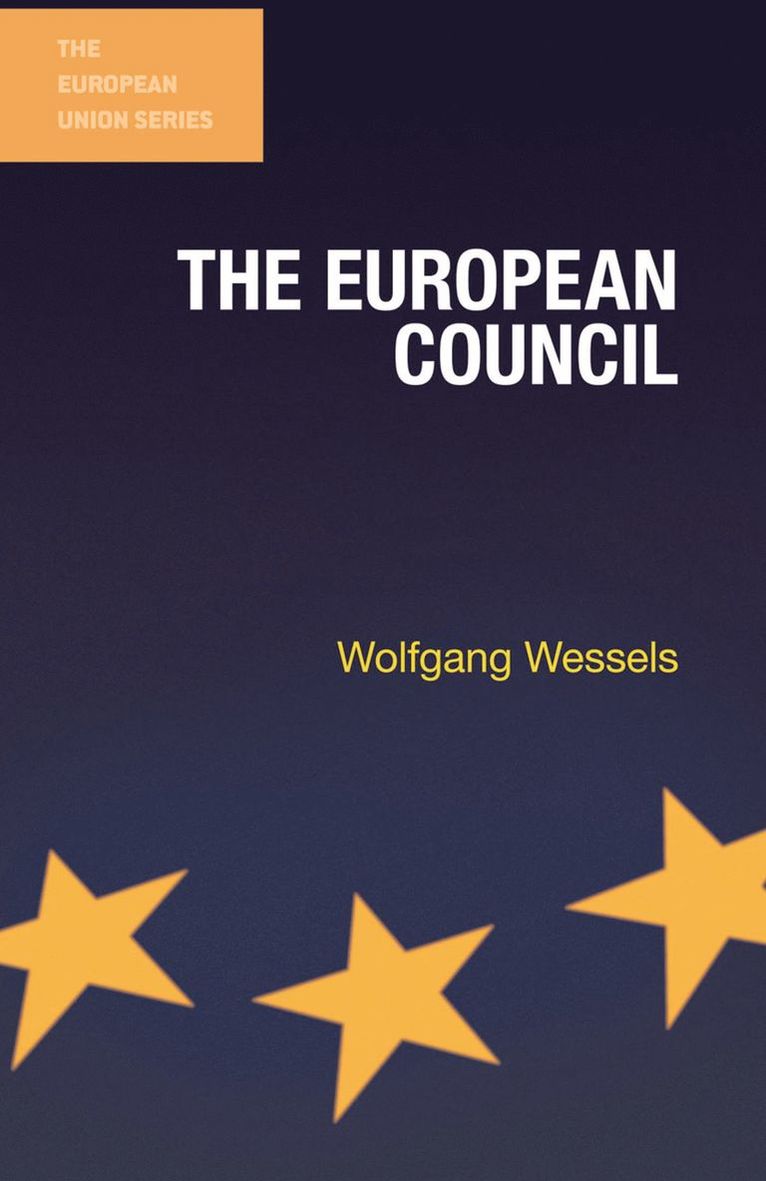
This revised edition of The European Council by Wessels and Schramm offers comprehensive coverage of the institution's development since the mid-1970s. The text offers a nuanced assessment of the European Council’s impact on EU governance and institutional balance whilst providing readers with a theoretical framework and conceptual models for understanding the significance of the European Council.New features in this edition include expanded discussions on the three key policy areas addressed in the text: economic governance, external action, and the realm of freedom, security, and justice. These updates encompass crucial developments such as the euro crisis, the migration crisis, and Brexit. Moreover, the text provides current up-to-date coverage of recent EU priorities, including responses to the Covid-19 pandemic, climate policies, the conflict in Ukraine, and the prospects of EU enlargement.As a highly accessible and comprehensive text, this updated edition is key for 2nd and 3rd year undergraduate students studying Politics and International Relations as well as postgraduate students taking European Studies courses.
Wolfgang Wessels is Jean Monnet Professor of Political Science, University of Cologne, Germany.Lucas Schramm is Assistant Professor at the Geschwister Scholl Institute, the Department for Political Science at LMU Munich, Germany.
Preface: The Fascination and Frustration of Studying a Key InstitutionPart I: The European Council: Introduction, History, and Analytical Perspectives1. Introduction: The Many Faces of the European Council2. The European Council: Historical Paths Towards Institutionalised Summitry 3. The Growth of the European Council: Generations of Leaders and Institutional Trajectory4. Multiple Approaches for Understanding a Contested Institution: Three ModelsPart II: Activities, Agreements, and Acts5. Deepening: The Constitutional Architect6. Widening: The Master of Membership7. Economic Governance: Towards a ‘gouvernement économique’?8. External Action: In Search of a Coherent and Effective Global Role9. The Area of Freedom, Security and Justice: Exercising Pre-Legislative FunctionsPart III: Inside the European Council: The Dynamics of Decision-Making10. The Presidency: Charismatic Master or Facilitating Manager?11. Rules for Organisation: The Search for an Optimal Institutional Arrangement12. Decision-Making: The Ways to Compromises and ConsensusPart IV: The Role of the European Council within the EU Architecture13. Political and Procedural Steering: General Functions and Specific Powers14. Towards an Institutional (Im)Balance? Trends in Interinstitutional RelationsPart V: Conclusions and Outlook: A Key Institution’s Rise – and Decline?15. The European Council: The Union’s Key Crisis Manager16. Perspectives of an Institution: Looking Back to Look ForwardAppendix: SourcesBibliographyIndex
Anyone who wants to understand the EU must understand how the European Council works. Or vice versa. This book is an academic yet accessible guide to this journey. It offers exceptionally clear insights into the past and the future. A must-read for future Presidents of the European Council!
This revised edition of The European Council by Wessels and Schramm offers comprehensive coverage of the institution's development since the mid-1970s. The text offers a nuanced assessment of the European Council’s impact on EU governance and institutional balance whilst providing readers with a theoretical framework and conceptual models for understanding the significance of the European Council.New features in this edition include expanded discussions on the three key policy areas addressed in the text: economic governance, external action, and the realm of freedom, security, and justice. These updates encompass crucial developments such as the euro crisis, the migration crisis, and Brexit. Moreover, the text provides current up-to-date coverage of recent EU priorities, including responses to the Covid-19 pandemic, climate policies, the conflict in Ukraine, and the prospects of EU enlargement.As a highly accessible and comprehensive text, this updated edition is key for 2nd and 3rd year undergraduate students studying Politics and International Relations as well as postgraduate students taking European Studies courses.
Wolfgang Wessels is Jean Monnet Professor of Political Science, University of Cologne, Germany.Lucas Schramm is Assistant Professor at the Geschwister Scholl Institute, the Department for Political Science at LMU Munich, Germany.
Preface: The Fascination and Frustration of Studying a Key InstitutionPart I: The European Council: Introduction, History, and Analytical Perspectives1. Introduction: The Many Faces of the European Council2. The European Council: Historical Paths Towards Institutionalised Summitry 3. The Growth of the European Council: Generations of Leaders and Institutional Trajectory4. Multiple Approaches for Understanding a Contested Institution: Three ModelsPart II: Activities, Agreements, and Acts5. Deepening: The Constitutional Architect6. Widening: The Master of Membership7. Economic Governance: Towards a ‘gouvernement économique’?8. External Action: In Search of a Coherent and Effective Global Role9. The Area of Freedom, Security and Justice: Exercising Pre-Legislative FunctionsPart III: Inside the European Council: The Dynamics of Decision-Making10. The Presidency: Charismatic Master or Facilitating Manager?11. Rules for Organisation: The Search for an Optimal Institutional Arrangement12. Decision-Making: The Ways to Compromises and ConsensusPart IV: The Role of the European Council within the EU Architecture13. Political and Procedural Steering: General Functions and Specific Powers14. Towards an Institutional (Im)Balance? Trends in Interinstitutional RelationsPart V: Conclusions and Outlook: A Key Institution’s Rise – and Decline?15. The European Council: The Union’s Key Crisis Manager16. Perspectives of an Institution: Looking Back to Look ForwardAppendix: SourcesBibliographyIndex
Anyone who wants to understand the EU must understand how the European Council works. Or vice versa. This book is an academic yet accessible guide to this journey. It offers exceptionally clear insights into the past and the future. A must-read for future Presidents of the European Council!