
Del i serien Routledge Library Editions: Phenomenology
Dual Vision
Alfred Schutz and the Myth of Phenomenological Social Science
Inbunden, Engelska, 2013
3 209 kr
Beställningsvara. Skickas inom 10-15 vardagar. Fri frakt för medlemmar vid köp för minst 249 kr.
Finns i fler format (1)
This study, originally published in 1977, focuses on a critical examination of the life-work of Alfred Schutz, the most important and influential ‘father’ of several recent schools of empirical social research.The author shows why Shutz and his followers fail in their attempts to ‘humanize’ empirical social science. The problems they encounter, he argues, are due to their attempt to achieve a methodological synthesis of self-determining subjectivity and empirical criteria of validation, based on Schutz’s heuristic adoption of relevant ideas from Weber and Husserl. This is, in effect, an artificial union of subjectivity and objectivity – their ‘dual vision’ – that satisfies neither phenomenological nor naturalist perspectives. Dr Gorman suggests that the radical implications of phenomenology must lead to a consistent, socially-conscious method of inquiry, and, in a final chapter, he re-defines the methodological implications of phenomenology with the aid of existential and Marxist categories.
Produktinformation
- Utgivningsdatum2013-08-08
- Mått156 x 234 x undefined mm
- Vikt476 g
- FormatInbunden
- SpråkEngelska
- SerieRoutledge Library Editions: Phenomenology
- Antal sidor242
- FörlagTaylor & Francis Ltd
- ISBN9780415859677
Tillhör följande kategorier
Hoppa över listan


Mer från samma serie
Michotte's Experimental Phenomenology of Perception
Georges Thinés, Alan Costall, George Butterworth
Inbunden, 2013
3 209 kr
Hoppa över listan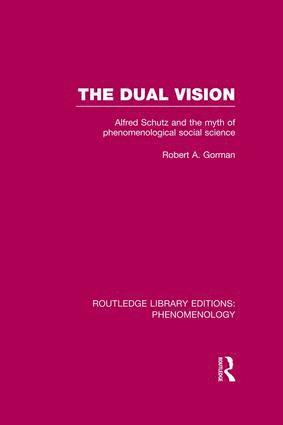



Du kanske också är intresserad av
- Nyhet
Del 3
Clinical Phenomenology and Cognitive Psychology
David Fewtrell, Kieron O'Connor
Inbunden, 2013
3 309 kr