
Creating a Culture of Mindful Innovation in Higher Education
Inbunden, Engelska, 2022
1 589 kr
Beställningsvara. Skickas inom 5-8 vardagar. Fri frakt för medlemmar vid köp för minst 249 kr.
Finns i fler format (1)
Offers a vision for innovation in higher education focused on societal progress and human development, as well as for higher education's role within a broader culture of innovation.Higher education institutions have traditionally nurtured artistic and scientific development and served as catalysts for innovative ideas and products. However, contemporary discourse too often relegates the concept of innovation to the private sector, where the rhetoric of "disruption" frequently reduces innovation to economic terms. As a result, innovations that could benefit society instead exacerbate existing inequities, and the environmental factors that stimulate long-term innovative progress are neglected.Creating a Culture of Mindful Innovation in Higher Education offers a different vision by identifying the conditions that enable college and university administrators, faculty, and staff to promote an innovative institutional culture. Mindful innovation is defined through six central tenets: societal impact; the necessity of failure; creativity through diversity; respect for autonomy and expertise; thoughtful consideration for the dimensions of time, efficiency, and trust; and the incentivization of intrinsic motivation and progress over scare tactics and disruption. Michael Lanford and William G. Tierney offer a clearheaded analysis of the challenges and opportunities in creating a culture of mindful innovation and argue that the institutions that do so will be poised to lead entrepreneurial endeavors, scientific progress, and greater social equity in the twenty-first century.
Produktinformation
- Utgivningsdatum2022-06-01
- Mått152 x 229 x 15 mm
- Vikt363 g
- FormatInbunden
- SpråkEngelska
- Antal sidor194
- FörlagState University of New York Press
- ISBN9781438487632
Tillhör följande kategorier
Hoppa över listan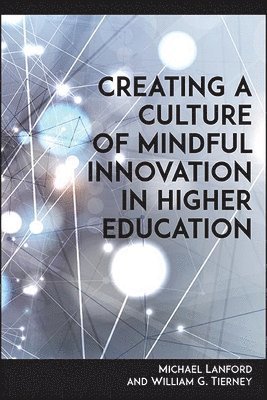







Du kanske också är intresserad av
Creating a Culture of Mindful Innovation in Higher Education
Michael Lanford, William G. Tierney
Häftad, 2022
559 kr
Postsecondary Play
William G. Tierney, Zoë B. Corwin, Tracy Fullerton, Gisele Ragusa
Inbunden, 2014
689 kr