
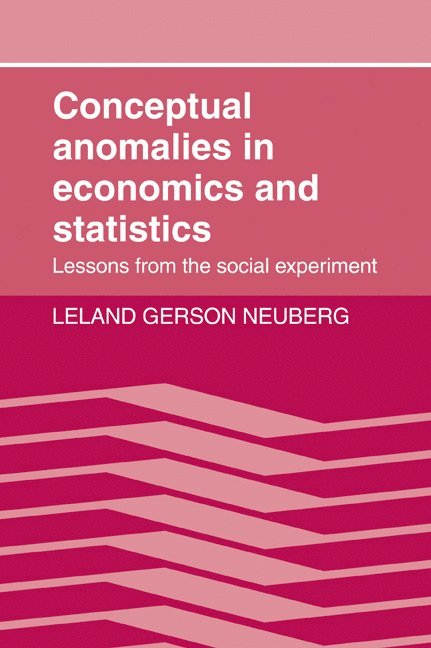
Conceptual Anomalies in Economics and Statistics
Lessons from the Social Experiment
Inbunden, Engelska, 1989
2 009 kr
Beställningsvara. Skickas inom 5-8 vardagar. Fri frakt för medlemmar vid köp för minst 249 kr.
Finns i fler format (1)
Do economics and statistics succeed in explaining human social behaviour? To answer this question. Leland Gerson Neuberg studies some pioneering controlled social experiments. Starting in the late 1960s, economists and statisticians sought to improve social policy formation with random assignment experiments such as those that provided income guarantees in the form of a negative income tax. This book explores anomalies in the conceptual basis of such experiments and in the foundations of statistics and economics more generally. Scientific inquiry always faces certain philosophical problems. Controlled experiments of human social behaviour, however, cannot avoid some methodological difficulties not evident in physical science experiments. Drawing upon several examples, the author argues that methodological anomalies prevent microeconomics and statistics from explaining human social behaviour as coherently as the physical sciences explain nature. He concludes that controlled social experiments are a frequently overrated tool for social policy improvement.
Produktinformation
- Utgivningsdatum1989-05-26
- Mått152 x 228 x 26 mm
- Vikt652 g
- FormatInbunden
- SpråkEngelska
- Antal sidor380
- FörlagCambridge University Press
- ISBN9780521304443
Tillhör följande kategorier
Hoppa över listan



Du kanske också är intresserad av
Del 44
Del 47
Optimization: Methods and Applications, Possibilities and Limitations
H.W. Bergmann
Häftad, 1989
1 439 kr
Del 43
Recent Advances in Computational Fluid Dynamics
C.C. Chao, Steven A. Orszag, W. Shyy
Häftad, 1989
1 439 kr
Del 101
Numerische Simulation dreidimensionaler Umformvorgänge mit Einbezug des Temperaturverhaltens
Jürgen Gerhardt
Häftad, 1989
729 kr
Del 8