
Climate Governance at the Crossroads
Experimenting with a Global Response after Kyoto
Inbunden, Engelska, 2011
1 849 kr
Beställningsvara. Skickas inom 5-8 vardagar. Fri frakt för medlemmar vid köp för minst 249 kr.
Finns i fler format (1)
The global governance of climate change is in flux. Conventional strategies of addressing climate change through universal, interstate negotiations--the most prominent of which is the Kyoto Protocol--have been stymied by the gaps that exist between the negotiating powers of states, rendering such initiatives stagnant and ineffectual. In response, a number of new actors and processes have begun to challenge the traditionally exclusive authority of nation-states to create rules and manage environmental problems via multi-national treaties. Dozens of innovative climate response initiatives, or "governance experiments," have emerged at multiple levels of politics and across multiple jurisdictions: individuals, cities, states/provinces, corporations, and even new multilateral initiatives. Climate Governance at the Crossroads explains how and why these new governance experiments have emerged, drawing upon a database of such initiatives to ascertain how these initiatives fit together and how they influence what is defined as environmental governance. In assessing the relational impact of these initiatives (whether they complement each other or clash; whether they can be scaled up or down; and whether they can be expanded beyond their current jurisdictional and geographic boundaries), Matthew Hoffmann provides insight into whether this experimentation is likely to result in an effective response to climate change. Additionally, he draws broader conclusions about how we understand global governance, addressing questions of how we understand authority and what we accept as modes of rule-making in global political spaces.
Produktinformation
- Utgivningsdatum2011-03-24
- Mått236 x 163 x 20 mm
- Vikt451 g
- FormatInbunden
- SpråkEngelska
- Antal sidor240
- FörlagOUP USA
- ISBN9780195390087
Tillhör följande kategorier
Hoppa över listan



Mer från samma författare
Transnational Climate Change Governance
Harriet Bulkeley, Liliana B. Andonova, Michele M. Betsill, Daniel Compagnon, Thomas Hale, Matthew J. Hoffmann, Peter Newell, Matthew Paterson, Charles Roger, Stacy D. VanDeveer
Häftad, 2018
629 kr
Hoppa över listan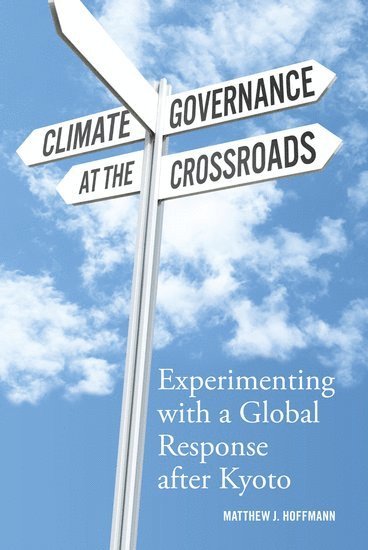




Du kanske också är intresserad av
Transnational Climate Change Governance
Harriet Bulkeley, Liliana B. Andonova, Michele M. Betsill, Daniel Compagnon, Thomas Hale, Matthew J. Hoffmann, Peter Newell, Matthew Paterson, Charles Roger, Stacy D. VanDeveer
Häftad, 2018
629 kr
- Nyhet
- Nyhet
- Nyhet
Del 6
- Nyhet
Del 11