
Del i serien Text, Speech and Language Technology
Breadth and Depth of Semantic Lexicons
Inbunden, Engelska, 1999
2 209 kr
Beställningsvara. Skickas inom 10-15 vardagar. Fri frakt för medlemmar vid köp för minst 249 kr.
Most books about computational (lexical) semantic lexicons deal with the depth (or content) aspect of lexicons, ignoring the breadth (or coverage) aspect. This book presents an attempt to address both issues: content and coverage of computational semantic lexicons. Moreover, it addresses issues in implemented systems such as the application time of lexical rules. Lexical rules and lexical underspecification are also contrasted in implemented systems. The main approaches in the field of computational (lexical) semantics are represented in the present book (including Wordnet, CyC, Mikrokosmos, Generative Lexicon). This book embraces several fields (and subfields) as different as: linguistics (theoretical, computational, semantics, pragmatics), psycholinguistics, cognitive science, computer science, artificial intelligence, knowledge representation, statistics and natural language processing.
Produktinformation
- Utgivningsdatum1999-11-30
- Mått156 x 234 x 24 mm
- Vikt696 g
- FormatInbunden
- SpråkEngelska
- SerieText, Speech and Language Technology
- Antal sidor330
- Upplaga1999
- FörlagKluwer Academic Publishers
- ISBN9780792360391
Tillhör följande kategorier
Hoppa över listan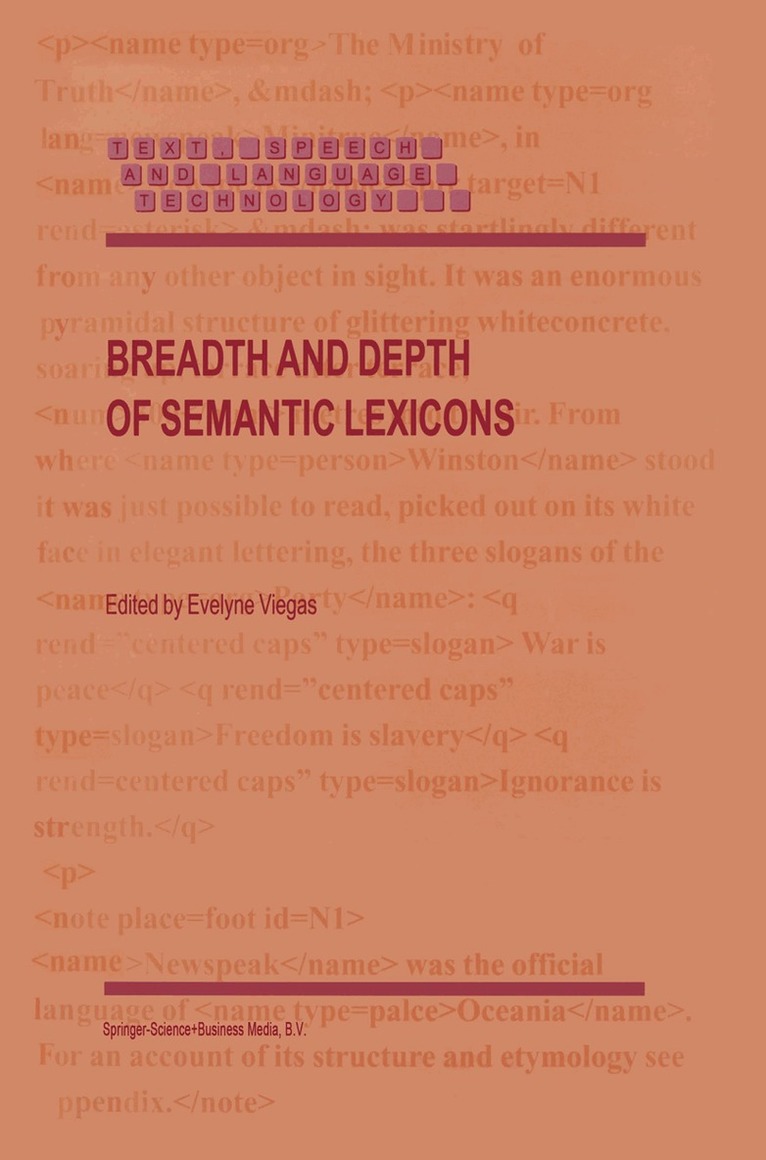









Du kanske också är intresserad av
- Nyhet
Del 3
- Nyhet
Del 11
- Nyhet
- Nyhet
Del 1
- Nyhet
Del 4
- Nyhet
Del 4
- Nyhet
Del 6
Del 3