
Del i serien Critical Perspectives on Empire
An Empire of Facts
Colonial Power, Cultural Knowledge, and Islam in Algeria, 1870-1914
Häftad, Engelska, 2009
689 kr
Tillfälligt slut
Finns i fler format (1)
An Empire of Facts presents a fascinating account of the formation of French conceptions of Islam in France's largest and most important colony. During the period from 1870 to 1914, travelers, bureaucrats, scholars, and writers formed influential and long-lasting misconceptions about Islam that determined the imperial cultural politics of Algeria and its interactions with republican France. Narratives of Islamic mysticism, rituals, gender relations, and sensational crimes brought unfamiliar cultural forms and practices to popular attention in France, but also constructed Algerian Muslims as objects for colonial intervention. Personal lives and interactions between Algerian and French men and women inflected these texts, determining their style, content, and consequences. Drawing on sources in Arabic and French, this book places such personal moments at the heart of the production of colonial knowledge, emphasizing the indeterminacy of ethnography, and its political context in the unfolding of France's empire and its relations with Muslim North Africa.
Produktinformation
- Utgivningsdatum2009-11-19
- Mått152 x 228 x 15 mm
- Vikt520 g
- FormatHäftad
- SpråkEngelska
- SerieCritical Perspectives on Empire
- Antal sidor328
- FörlagCambridge University Press
- ISBN9780521734349
Tillhör följande kategorier
Hoppa över listan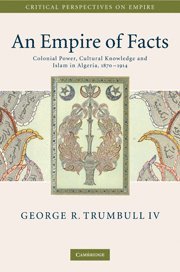







Du kanske också är intresserad av
- Nyhet
Del 3
- Nyhet
Del 11
- Nyhet
Del 4
- Nyhet
Del 6
Del 1
Del 3
Del 2
Del 7
- Nyhet
Del 1