
Del 251
Del 273 i serien Geophysical Monograph Series
Isotopic Constraints on Earth System Processes
Inbunden, Engelska, 2022
2 779 kr
Beställningsvara. Skickas inom 5-8 vardagar. Fri frakt för medlemmar vid köp för minst 249 kr.
Using isotopes as a tool for understanding Earth processesFrom establishing the absolute age of the Earth to providing a stronger understanding of the nexus between geology and life, the careful measurement and quantitative interpretation of minor variations in the isotopic composition of Earth’s materials has provided profound insight into the origins and workings of our planet.Isotopic Constraints on Earth System Processes presents examples of the application of numerous different isotope systems to address a wide range of topical problems in Earth system science.Volume highlights include: examination of the natural fractionation of non-traditional stable isotopesutilizing isotopes to understand the origin of magmas and evolution of volcanic systemsapplication of isotopes to interrogate and understand Earth’s Carbon and Oxygen cyclesexamination of the geochemical and hydrologic processes that lead to isotopic fractionationapplication of isotopic reactive transport models to decipher hydrologic and biogeochemical processesThe American Geophysical Union promotes discovery in Earth and space science for the benefit of humanity. Its publications disseminate scientific knowledge and provide resources for researchers, students, and professionals.
Produktinformation
- Utgivningsdatum2022-06-01
- Mått218 x 277 x 20 mm
- Vikt1 157 g
- FormatInbunden
- SpråkEngelska
- SerieGeophysical Monograph Series
- Antal sidor352
- FörlagJohn Wiley & Sons Inc
- ISBN9781119594970
Tillhör följande kategorier
Hoppa över listan
Mer från samma serie
Del 197
Auroral Phenomenology and Magnetospheric Processes
Andreas Keiling, Eric Donovan, Fran Bagenal, Tomas Karlsson
Inbunden, 2012
2 269 kr
Del 100
Del 107
Del 152
Del 156
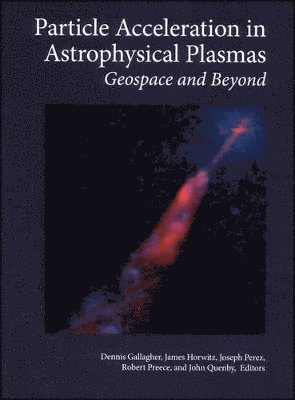
Particle Acceleration in Astrophysical Plasmas
Dennis Gallagher, James Horwitz, Joseph Perez, Robert Preece, John Quenby
Inbunden, 2005
1 569 kr
Del 160
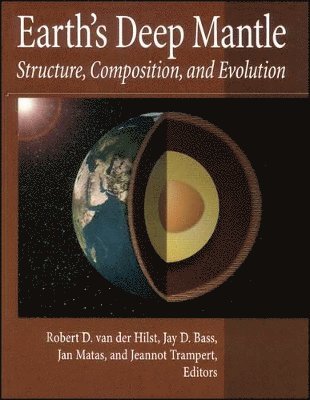
Earth's Deep Mantle
Robert D. van der Hilst, Jay D. Bass, Jan Matas, Jeannot Trampert
Inbunden, 2005
1 429 kr
Del 165
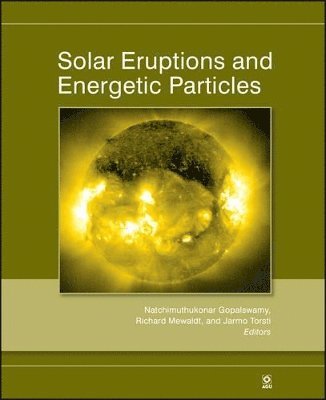
Solar Eruptions and Energetic Particles
Natchimuthukonar Gopalswamy, Richard Mewaldt, Jarmo Torsti
Inbunden, 2006
1 509 kr
Del 166
Back-Arc Spreading Systems
David M. Christie, David M. Christie, Charles R. Fisher, Sang-Mook Lee, Sharon Givens
Häftad, 2006
1 429 kr
Del 176
Exploring Venus as a Terrestrial Planet
Esposito, Larry W. Esposito, Ellen R. Stofan, Thomas E. Cravens
Inbunden, 2007
1 439 kr
Hoppa över listan









Du kanske också är intresserad av
Foundations for a Low-Carbon Energy System in China
Henry Lee, Daniel P. Schrag, Matthew Bunn, Michael Davidson, Wei Peng, Wang Pu, Mao Zhimin
Inbunden, 2021
2 579 kr
- Nyhet
Del 3
- Nyhet
Del 11
- Nyhet
Del 6
Del 2
Del 1
- Nyhet
- Nyhet
- Nyhet
- Nyhet