Beställningsvara. Skickas inom 7-10 vardagar. Fri frakt för medlemmar vid köp för minst 249 kr.
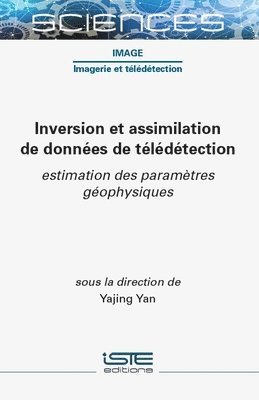
Remote sensing data are now the primary sources for observing Earth and the Universe. Data inversion and assimilation techniques are the main tools for estimating and predicting the geophysical parameters that characterize the evolution of our planet and the Universe, using remote sensing data. Inversion and Data Assimilation in Remote Sensing explores recent advances in the inversion and assimilation of remote sensing data. It presents traditional and current neural network methods, as well as a number of topics where these methods have been developed or adapted to suit the specific nature of the field. The assimilation section covers prediction problems in volcanology and glaciology. Lastly, the inversion section covers biomass inversion using SAR images, bio-physio-hydrological inversion in coastal areas using multi- and hyperspectral images, and astrophysical inversion using telescope data.
Yajing Yan is a lecturer at the LISTIC laboratory, Université Savoie Mont Blanc, France. Her research focuses on multi-temporal InSAR analysis, remote sensing data fusion and assimilation, and machine learning.
Preface xiYajing YANPart 1 Data Assimilation 1Chapter 1 Methods for Assimilation of Observations: Application to Numerical Weather Prediction 3Olivier TALAGRAND1.1. Introduction 31.2. The linear and Gaussian case 61.2.1. Variational form 81.3. Optimal interpolation – three-dimensional variational assimilation 101.4. Taking the dynamics of the flow into account 121.4.1. The Kalman Filter 161.4.2. Four-dimensional variational assimilation 221.4.3. Ensemble methods 271.4.4. Stability and instability 291.5. Particle filters 301.6. Artificial intelligence 321.7. Extensions and applications 331.8. References 34Chapter 2 Ensemble Data Assimilation in Volcanology 39Mary Grace BATO, Virginie PINEL and Yajing YAN2.1. Volcano monitoring and eruption forecasting 392.2. Ensemble data assimilation 422.2.1. Volcanic data assimilation using the ensemble Kalman filter 432.2.2. The dynamic model 442.2.3. Data observations 472.3. Potentiality assessment of volcanic data assimilation for eruption forecasting based on synthetic simulations 502.3.1. EnKF formulation 512.3.2. Synthetic observations 522.3.3. Experiment setup 532.3.4. Results and discussions 552.3.5. Implications to real-time volcano monitoring 612.4. Application: The 2004–2014 inter-eruptive activity at Grímsvötn volcano, Iceland 622.4.1. Implications of the change in magma supply rate at Grímsvötn 642.5. Conclusions and outlook 652.6. Acknowledgments 662.7. References 66Chapter 3 Data Assimilation in Glaciology 71Fabien GILLET-CHAULET3.1. Introduction 713.2. Predicting a paradigm shift for polar ice-sheet models 733.3. Principles of ice sheet dynamics 753.4. Parameter estimation 783.4.1. Variational methods 793.4.2. Bayesian methods 853.4.3. Classical inversion problems 853.5. State and parameter estimation 903.6. Conclusions and outlook 923.7. References 93Part 2 Inversion 103Chapter 4 Probabilistic Inversion Methods 105Alexandrine GESRET4.1. Local methods versus global methods 1054.2. Bayesian formalism 1074.3. Model parameterization 1114.3.1. Layered models 1124.3.2. Wavelets 1134.3.3. Voronoi tessellation 1154.3.4. The Johnson Mehl tessellation 1164.4. Markov chain Monte Carlo-based sampling algorithms 1184.4.1. The Metropolis-Hastings algorithm 1214.4.2. Simulated annealing 1234.4.3. Interacting Markov chains 1254.4.4. The reversible jump Metropolis-Hastings algorithm 1294.5. Conclusions and outlook 1324.6. References 134Chapter 5 Modeling Radar Backscattering from Forests: A First Step to Inversion 139Elise COLIN and Laetitia THIRION-LEFEVRE5.1. Introduction 1395.2. Vegetation model historical background 1415.2.1. Evolution of measurements and their understanding 1425.2.2. What should be remembered? And what prospects? 1455.3. How to choose a model for inversion? 1465.3.1. Different inversion approaches 1465.3.2. Choosing according to the intended purpose 1485.3.3. Validity and validation domain 1525.3.4. Summarizing the choice of model 1535.4. Biomass inversion 1545.4.1. Challenges 1545.4.2. Regression of backscatter coefficient curves 1555.4.3. RVoG model in PolInSAR 1565.4.4. Approximate model inversion 1585.4.5. Metamodels 1595.4.6. What should be remembered and expected? 1605.5. Conclusions and outlook 1605.6. References 163Chapter 6 Radiative Transfer Model Inversion and Application to Coastal Observation 169Touria BAJJOUK, Audrey MINGHELLI, Malik CHAMI and Tristan PETIT6.1. Introduction 1696.2. Principle and treatment method 1706.2.1. Inherent optical water properties 1706.2.2. Apparent optical properties of water 1716.3. Biophysical model of radiative transfer 1726.3.1. Data and preprocessing 1736.3.2. Estimation and inversion methods 1766.3.3. Validation methods for inversion products 1776.3.4. Uncertainty about inversion-estimated parameters 1806.4. Examples of applications in coastal areas 1826.4.1. SPM/CHL estimate 1826.4.2. Bathymetry estimation 1846.4.3. Spatial characterization of the seabed 1876.5. Conclusions and outlook 1906.6. References 193Chapter 7 Deep-learning Analysis of Cherenkov Telescope Array Images 201Mikaël JACQUEMONT, Thomas VUILLAUME, Alexandre BENOIT, Gilles MAURIN and Patrick LAMBERT7.1. Gamma astronomy 2017.1.1. Gamma radiation and observation method 2017.1.2. Analysis methods for Cherenkov images 2047.2. Deep neural networks 2057.2.1. Deep learning for gamma astronomy 2067.2.2. Multitasking learning 2077.2.3. Attention mechanisms 2097.2.4. Explainability of neural networks 2117.3. γ-PhysNet: a multitasking architecture for the complete reconstruction of gamma events 2127.3.1. Encoder 2127.3.2. Multitasking block 2137.3.3. Improving the encoder with attention 2147.4. Performance evaluation 2157.4.1. Dataset 2157.4.2. Data selection and preparation 2177.4.3. Model training 2177.4.4. Performance evaluation methodology 2187.4.5. Interest of multitasking and comparison with the standard method 2197.4.6. Energy regression 2207.4.7. Direction regression 2217.4.8. Impact of attention 2227.4.9. Understanding the effect of attention on robustness 2237.5. Conclusions and outlook 2267.6. Acknowledgments 2277.7. References 227List of Authors 233Index 235
Guillame Drevon, Vincent Kaufmann, Guillame (Luxembourg Institute of Socioeconomic Research (LISER)) Drevon, Switzerland) Kaufmann, Vincent (Polytechnique Federale de Lausanne (EPFL)
Jacques Besson, Jacques Besson, Frederic Lebon, Eric Lorentz, France) Besson, Jacques (CNRS, France) Lebon, Frederic (Aix-Marseille University, Mechanics and Acoustics Laboratory (LMA), France) Lorentz, Eric (EDF R&D
Manon Enjolras, Daniel Galvez, Mauricio Camargo, France) Enjolras, Manon (University of Lorraine, Chile) Galvez, Daniel (University of Santiago, France) Camargo, Mauricio (University of Lorraine
Jacques Besson, Jacques Besson, Frederic Lebon, Eric Lorentz, France) Besson, Jacques (CNRS, France) Lebon, Frederic (Aix-Marseille University, Mechanics and Acoustics Laboratory (LMA), France) Lorentz, Eric (EDF R&D