Beställningsvara. Skickas inom 5-8 vardagar. Fri frakt för medlemmar vid köp för minst 249 kr.
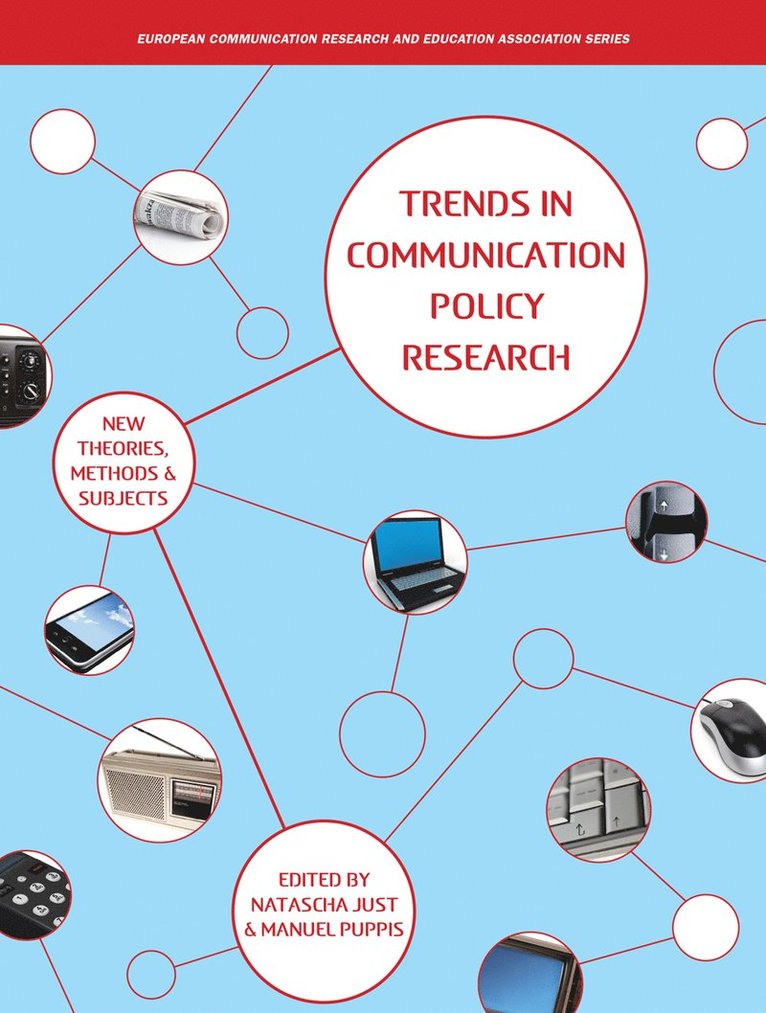
With contributions from leading international experts from within both the communications industry and academia, Trends in Communication Policy Research comprises the very latest developments in the theories, methods and practical applications of this dynamic field. Topical and politically relevant, this authoritative volume will prove an invaluable reference for students and scholars seeking to understand communication policy issues.
Natascha Just and Manuel Puppis are senior research and teaching associates at the Institute of Mass Communication and Media Research at the University of Zürich, Switzerland.
Chapter 1: Introduction – Natascha Just & Manuel Puppis Chapter 2: Communication Policy Research: Looking Back, Moving Forward – Natascha Just & Manuel PuppisPART I: NEW THEORIESChapter 3: Prospects and Pitfalls of Douglass North’s New Institutional Economics Approach for Global Media Policy Research – Jan LoisenChapter 4: ‘It’s the Idea, Stupid!’ How Ideas Challenge Broadcasting Liberalization – Matthias KunzlerChapter 5: The Accountability and Legitimacy of Regulatory Agencies in the Communication Sector – Manuel Puppis & Martino MaggettiChapter 6: Change and Divergence in Regulatory Regimes: A Comparative Study of Product Placement Regulation – Avshalom GinosarChapter 7: Technologies as Institutions: Rethinking the Role of Technology in Media Governance Constellations – Christian KatzenbachChapter 8: Veto Players and the Regulation of Media Pluralism: A New Paradigm for Media Policy Research? – Ulrike KlingerPART II: NEW METHODS Chapter 9: A Political Scientist’s Contribution to the Comparative Study of Media Systems in Europe: A Response to Hallin and Mancini – Peter HumphreysChapter 10: What We Talk about When We Talk about Document Analysis - Kari Karppinen & Hallvard MoeChapter 11: Qualitative Network Analysis: An Approach to Communication Policy Studies – Maria Löblich & Senta Pfaff-Rudiger Chapter 12: Towards a Media Policy Process Analysis Model and Its Methodological Implications – Hilde Van den BulckPART III: NEW SUBJECTSCONVERGENCEChapter 13: Battle of the Paradigms: Defining the Object and Objectives of Media/Communication Policy – Karol JakubowiczChapter 14: Content Control and Digital Television: Policy, Technology and Industry – Andrew T. Kenyon, Julian Thomas & Jason BoslandChapter 15: Regulating and Monitoring Online Activities of Public Service Broadcasters: The Case of Switzerland – Natascha Just, Michael Latzer & Florian SaurweinSTATE AIDChapter 16: Conditional Access for Public Service Broadcasting to New Media Platforms: EU State-Aid Policy vis-à-vis Public Service Broadcasting – the Dutch Case – Jo Bardoel & Marit VochtelooChapter 17: Film Support in the EU: The Uteca Case and the Future Challenges for the ‘Main Characters’ – Lucia BellucciChapter 18: New Approaches to the Development of Telecommunications Infrastructures in Europe? The Evolution of European Union Policy for Next-Generation Networks – Seamus SimpsonPARTICIPATION, POWER & THE ROLE OF GENDERChapter 19: Public Service Television in European Union Countries: Old Issues, New Challenges in the ‘East’ and the ‘West’ – Peter Bajomi-Lazar, Vaclav Stetka & Miklós SukosdChapter 20: Civil Society and Media Governance: A Participatory Approach – Pietro Rossi & Werner A. MeierChapter 21: Stepping Out of the Comfort Zone: Unfolding Gender Conscious Research for Communication and Cultural Policy Theory – Katharine Sarikakis
'The depth of ... [the paper's] scholarship is clearly apparent and demonstrated.' – James Alleman, Communications & Strategies
Claudia Alvares, Tonny Krijnen, Sofie Van Bauwel, Claudia (Universidade Lusofona) Alvares, Culture and Communication) Krijnen, Tonny (Erasmus School of History, Sofie (Ghent University) Van Bauwel, Sofie van Bauwel
Bart Cammaerts, Nico Carpentier, Bart (London School of Economics and Political Science) Cammaerts, Czech Republic) Carpentier, Nico (Charles University