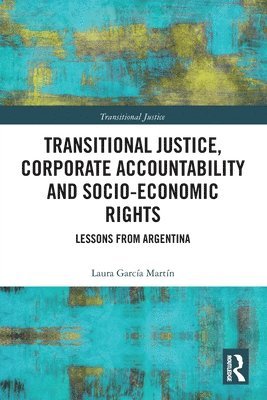
This book explores the intersection of two emergent and vibrant fields of study in international human rights law: transitional justice and corporate accountability for human rights abuses. While both have received significant academic and political attention, the potential links between them remain largely unexplored. This book addresses the normative question of how international human rights law should deal with corporate accountability and violations of economic, social and cultural rights in transitional justice processes. Drawing on the Argentinian transitional justice process, the book outlines the theoretical and practical challenges of including corporate accountability in transitional justice processes through existing mechanisms. Offering specific insights about how to deal with those challenges, it argues that consideration of the role of all actors, and the whole spectrum of human rights violated, is crucial to properly address the root causes of violence and conflict as well as to contribute to a sustainable and positive peace.This interdisciplinary book will be of interest to students and scholars of transitional justice, human rights law, corporate law and international law.
Laura García Martín is a postdoctoral researcher and teaching assistant at University of Seville and University of Antwerp. Her research interests include the socio-economic dimension of transitional justice and business and human rights.
Book AbstractList of AbbreviationsAcknowledgmentsIntroductionPART I – TRANSITIONAL JUSTICE AND SOCIO-ECONOMIC RIGHTSChapter 1 - Analysing the Transitional Justice paradigmIntroductionBackground and evolution of Transitional JusticeDefining the Transitional Justice ParadigmTransitional Justice Processes and MechanismsTruthJusticeReparationsInstitutional ReformTransitional Justice TheoriesSocio-political aspects of Transitional Justice Intermediate conclusions: A unique model of transitional justice? Chapter 2 – Socio-economic Rights in Transitional JusticeIntroduction Contextualising socio-economic rights in International law Labour rights as socio-economic rights: a particular focus on freedom of association at the workplaceLabour rights as human rightsFreedom of association at the workplace: the right to form and join trade unions and the right to collective bargainTraditional invisibility of socio-economic rights in transitional justice contextsAddressing socio-economic rights in transitional justice processesTruth and reconciliation commissions Judicial ProcessesReparations policiesInstitutional reformIntermediate conclusions: the added value of addressing socio-economic rights in transitional justicePART II: CORPORATE ACCOUNTABILITY IN TRANSITIONAL JUSTICEChapter 3 – Corporate legal accountability for human rights abusesIntroductionClarifying the notion of corporate complicity for human rights abusesPolicy meaning and legal implicationsCategories of corporate complicityDirect corporate complicityIndirect complicitySilent complicityCorporate accountability under the existing legal regimesInternational and domestic criminal lawCorporate criminal responsibilityAccomplice liability under domestic criminal lawEnforcement mechanisms and practical obstaclesCivil law of remediesElements of legal liabilityCausation and complicityAllocating liability within corporate groupsSpecial mention to the Alien Tort StatuteEnforcement mechanisms and practical obstaclesInternational human rights lawBackground and recent developmentsThe UN Guiding Principles on Business and Human RightsPillar I: the State’s duty to protectPillar II: the corporate responsibility to respectPillar III: the right of access to remedyEnforcement mechanisms and practical obstaclesIntermediate conclusions: the challenging task of holding corporations legally accountable for human rights abusesChapter 4 – Linking corporate accountability and transitional justiceIntroductionEngaging corporations in peacebuilding strategiesChallenges for the international framework of business and human rights in transitional justiceAddressing corporate accountability and socio-economic rights in transitional justice Truth processJustice processReparation processInstitutional reform processIntermediate conclusions: The need to address corporate accountability in transitional justicePART III – A CASE STUDY: ARGENTINAChapter 5 - Proceso de Reorganización Nacional: the dark ages of Argentinian history (1976-1983)Introduction International and national backgroundCoup and establishment of military juntasMilitary juntasEconomic policy and social repressionCivilian involvement: a special focus on corporations and economic groupsWorkers as a target of repressionThe extended notion of ‘subversion’Suppression of workers’ rights and trade unions interventionHuman rights violationsIntermediate conclusions: business involvement in human rights violations Chapter 6 - Nunca Más: The transitional justice process in ArgentinaIntroductionPolitical stages of the transitional justice process in ArgentinaFirst period- new democratic governments and first accountability initiatives (1983-1989)Second period - amnesty and pardons (1989-2003)Third period – new accountability era (2003-2015)Current stage and challengesTransitional justice mechanisms and accountability for socio-economic rights TruthArgentina’s truth commission: CONADEPTruth trialsJustice Domestic trialsLawsuits in foreign courtsReparations Institutional ReformCorporate accountability and the transitional justice process in ArgentinaIntermediate conclusions: Argentina’s transitional justice approach to corporate accountability and socio-economic rightsConclusionsBibliographyAnnex – List of interviewsIndex