
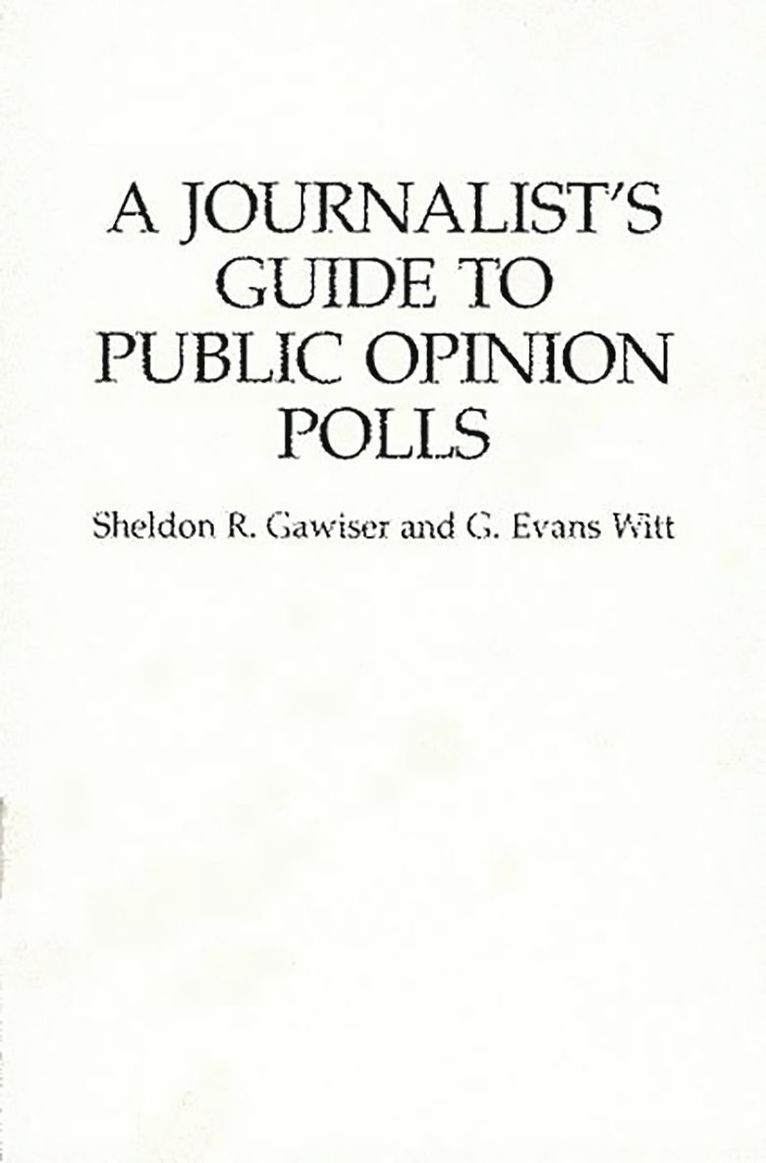
Journalist's Guide to Public Opinion Polls
Inbunden, Engelska, 1994
1 359 kr
Beställningsvara. Skickas inom 10-15 vardagar. Fri frakt för medlemmar vid köp för minst 249 kr.
Finns i fler format (1)
This straightforward text provides journalists, both professional and student, with an explanation of the realities of an increasingly important facet of today's precision journalism--public opinion polling. The work aims to provide the skills necessary for evaluating and interpreting survey results accurately. After a brief review of the historical relationship between the press and public opinion, the authors examine the polling environment today. Then, step-by-step, they take the reader through the basics of journalistic uses of public opinion surveys and the questions to be asked by the journalist in evaluating a survey: who did the poll; who sponsored the poll; what were the survey questions and how were they worded; what is the sampling error; how to report poll results; how to put survey figures in context; and how to make and evaluate projections based upon polls. In addition, the text offers a review of statistical methods for the journalist and a 20 question checklist.
Produktinformation
- Utgivningsdatum1994-10-21
- Mått165 x 243 x 18 mm
- Vikt448 g
- FormatInbunden
- SpråkEngelska
- Antal sidor192
- FörlagBloomsbury Publishing Plc
- ISBN9780275947224
Tillhör följande kategorier
Hoppa över listan


Du kanske också är intresserad av
Wissens- und datenbankbasiertes Beratungssystem für die FE-Simulation von Umformprozessen
Andreas Greve
Häftad, 1994
739 kr