
Del 4
Del i serien Contemporary Trends and Issues in Science Education
Everyday Thoughts about Nature
A Worldview Investigation of Important Concepts Students Use to Make Sense of Nature with Specific Attention of Science
Inbunden, Engelska, 2000
1 439 kr
Beställningsvara. Skickas inom 10-15 vardagar. Fri frakt för medlemmar vid köp för minst 249 kr.
Finns i fler format (1)
Dr. Olcbee Lee SchoolofEducation, UniversityofMiami Coral Gables, Florida 33124 I remember my excitement and appreciation several years ago when I first read World View Theory and Science Education Research by Bill Cobern (1991). It was a comprehensive, theoretical discussion ofworldview theory in science education. I am delighted to see that Cobern has taken the next step to provide empirical accountsofworldview in Everyday Thoughts about Nature. . The primary goal of the book is to understand how typical- ninth grade students and their science teachers think about Nature or the natural world, and how their thoughts are related to science. In pursuing this goal, the book raises a basicquestion about the purpose ofscienceeducationfor the public: Should science education seek to educate "scientific thinkers" in the pattern of the science teachers? Or, should science education seek to foster sound science learning within the matrices ofvari- ous cultural perspectives? (p. 3) The answer to this question becomes clear, thanks to Cobern's excellent research and persuasivearguments.First, this research takes a humanistic approach in understanding what students and teachers think about Nature "through the language and ideas voluntarily expressed" (p. I). The research used multi- directional prompts and encouraged students and teachers to speak freely and at length in any directions they wished. This humanistic approach is stated clearly: "[T]he research seeks to illuminate some of the various ways in which students think aboutNature withoutjudging eventhe most unorthodox perspectives" (p. 14).
Produktinformation
- Utgivningsdatum2000-06-30
- Mått155 x 235 x 11 mm
- Vikt431 g
- FormatInbunden
- SpråkEngelska
- SerieContemporary Trends and Issues in Science Education
- Antal sidor166
- Upplaga2000
- FörlagKluwer Academic Publishers
- ISBN9780792363446
Tillhör följande kategorier
Hoppa över listan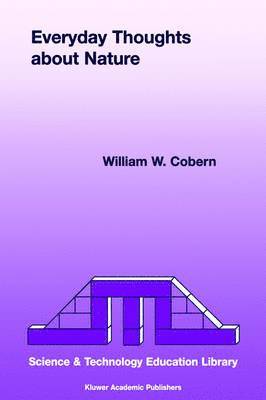








Du kanske också är intresserad av
Del 9
Del 4
Del 4
- Nyhet
Del 3
- Nyhet
Del 11
- Nyhet
Del 4
- Nyhet
Del 6
Del 1
Del 3
Del 2