
Del i serien Routledge Studies in Human Geography
Whose Urban Renaissance?
An international comparison of urban regeneration strategies
Häftad, Engelska, 2013
1 069 kr
Beställningsvara. Skickas inom 10-15 vardagar. Fri frakt för medlemmar vid köp för minst 249 kr.
The desire of governments for a 'renaissance' of their cities is a defining feature of contemporary urban policy. From Melbourne and Toronto to Johannesburg and Istanbul, government policies are successfully attracting investment and middle-class populations to their inner areas. Regeneration - or gentrification as it can often become - produces winners and losers. There is a substantial literature on the causes and unequal effects of gentrification, and on the global and local conditions driving processes of dis- and re-investment. But there is little examination of the actual strategies used to achieve urban regeneration - what were their intents, did they 'succeed' (and if not why not) and what were the specific consequences? Whose Urban Renaissance? asks who benefits from these urban transformations. The book contains beautifully written and accessible stories from researchers and activists in 21 cities across Europe, North and South America, Asia, South Africa, the Middle East and Australia, each exploring a specific case of urban regeneration. Some chapters focus on government or market strategies driving the regeneration process, and look closely at the effects. Others look at the local contingencies that influence the way these strategies work. Still others look at instances of opposition and struggle, and at policy interventions that were used in some places to ameliorate the inequities of gentrification. Working from these stories, the editors develop a comparative analysis of regeneration strategies, with nuanced assessments of local constraints and counteracting policy responses. The concluding chapters provide a critical comparison of existing strategies, and open new directions for more equitable policy approaches in the future. Whose Urban Renaissance? is targeted at students, academics, planners, policy-makers and activists. The book is unique in its geographical breadth and its constructive policy emphasis, offering a succinct, critical and timely exploration of urban regeneration strategies throughout the world.
Produktinformation
- Utgivningsdatum2013-09-09
- Mått156 x 234 x 18 mm
- Vikt476 g
- FormatHäftad
- SpråkEngelska
- SerieRoutledge Studies in Human Geography
- Antal sidor296
- FörlagTaylor & Francis Ltd
- ISBN9780415860710
Tillhör följande kategorier
Hoppa över listan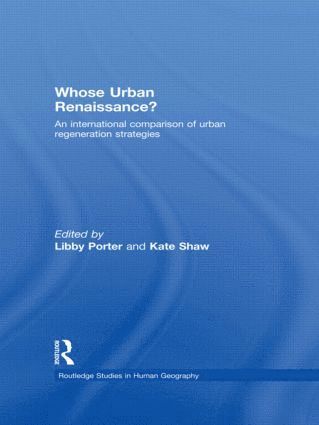

Du kanske också är intresserad av
Insurgencies and Revolutions
Haripriya Rangan, Mee Kam NG, Libby Porter, Jacquelyn Chase
Inbunden, 2016
3 849 kr
The Politics of Public Space Volume One
Libby Porter, Mark Jacques, Tom Andrews, Peter Chambers, Tania Davidge, Claire Martin
Häftad, 2020
319 kr
Across Theory and Practice
Monika Grubbauer, Kate Shaw, Monika Grubbauer, Kate Shaw
Häftad, 2018
539 kr