
Transformative Policy for Poor Women
A New Feminist Framework
Häftad, Engelska, 2019
1 019 kr
Beställningsvara. Skickas inom 10-15 vardagar. Fri frakt för medlemmar vid köp för minst 249 kr.
Finns i fler format (1)
What accounts for the oft-noted 'gap' between well-designed policies for women and their inadequate implementation? Why do such policies often fail to benefit the poorest women? How do policies address the intersecting inequalities of gender, class, caste, ethnic identity and race? What are the conditions under which policy may have transformative potential for poor women? This book answers these questions and many more. Presenting a new feminist framework for policy analysis that can account for policy failures, Bina Fernandez argues that these failures are often predictable and that it is necessary to unpack the actual policy practices within the policy-implementation gap. Recognising that policy is a multiply layered, contingent and politically contested discursive process, the author proposes the analysis of policy through four analytical categories: Constitutive Contexts, Representations, Practices and Consequences. Within each of these four categories, gender, class and ethnic identity are central axes of analysis. The framework is given substance through an empirical case-study of an anti-poverty policy in India, yet the wider relevance of the framework is validated through a discussion of parallels in the policy contexts of other developing countries. Transformative Policy for Poor Women provides an important and required framework to understand the gap between policy pronouncement and its praxis on the ground. These features make this book an important read for both scholars and practitioners seeking to understand policy in developing country contexts.'
Produktinformation
- Utgivningsdatum2019-06-10
- Mått156 x 234 x 12 mm
- Vikt453 g
- FormatHäftad
- SpråkEngelska
- Antal sidor208
- FörlagTaylor & Francis Ltd
- ISBN9781138379664
Tillhör följande kategorier
Hoppa över listan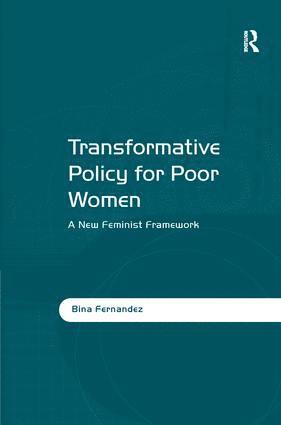




Du kanske också är intresserad av
Omvårdnadens grunder - paket
Sofia Almerud, Annica Backman, Anna-Karin Edberg, Anna Ehrenberg, My Engström, Katarina Göransson, Lena Marmstål Hammar, Stefan Nilsson, Lars Wallin, Helle Wijk, Joakim Öhlén, Lilas Ali, Anette Alvariza, Ann-Christine Andersson, Pia Andersson, Anna Anåker, Charlotta van Eggermont Arwidson, Margareta Asp, Åsa Audulv, Malin Axelsson, Mariette Bengtsson, Eva Benzein, Lena Berg, Monica Bergqvist, Eva-Karin Bergström, Ida Björkman, Catrin Björvell, Angela Bång, Carina Bååth, Josefin Bäckström, Karin Bölenius, David Edvardsson, Rakel Eklund, Inger Ekman, Mirjam Ekstedt, Ann Catrine Eldh, Karin Enskär, Sofia Erestam, Anneli Eriksson, Henrik Eriksson, Marie Ernsth Bravell, Jan Florin, Anna Forsberg, Henrietta Forsman, Anette Forss, Mio Fredriksson, Febe Friberg, Maria Grandahl, Tanja Gustafsson, Agneta Gånemo, Elizabeth Hanson, Malin Hansson, Amanda Hellström, Ingela Henoch, Inger Jansson, Maria Jirwe, Lena Johansson, Pauline Johansson, Unn-Britt Johansson, Birgitta Kerstis, Ann-Sofie Källberg, Ulrika Källman, Anita Kärner Köhler, Cecilia Larsdotter, Margret Lepp, Maria Lindström Nilsson, Mikael Lundmark, Anneli Löf, Lennart Magnusson, Catharina Melander, Jenny Milton, Beata Molin, Annika Nordin, Maria Norinder, Sepideh Olausson, Carina Persson, Kerstin Prignitz Sluys, Josefin Rahmqvist, Birgit Holritz Rasmussen, Anneli Ringblom, Karin C. Ringsberg, Ann Rudman, Ann-Marie Rydholm Hedman, Silje Rysst, Lars Sandman, Regina Santamäki Fischer, Britt-Inger Saveman, Johanna Sjömar, Karin Stenzelius, Anna Strömberg, Annelie J. Sundler, Märtha Sund Levander, Kristina Svantesson, Anna Swall, Susanne Syrén, Pia Tingström, Johanna Ulfvarson, Sara Wallström, Albert Westergren, Lena Wiklund Gustin, Ulrika Winblad
Häftad, 2025
1 569 kr
- Nyhet
- Nyhet
- Nyhet