
Trajectories of Empire
Transhispanic Reflections on the African Diaspora
Häftad, Engelska, 2022
789 kr
Beställningsvara. Skickas inom 5-8 vardagar. Fri frakt för medlemmar vid köp för minst 249 kr.
Finns i fler format (1)
Trajectories of Empire extends from the beginning of the Iberian expansion of the mid-fifteenth century, through colonialism and slavery, and into the twentieth and twenty-first centuries in Latin American republics. Its point of departure is the question of empire and its aftermath, as reflected in the lives of contemporary Latin Americans of African descent, and of their ancestors caught up in the historical process of Iberian colonial expansion, colonization, and the Atlantic slave trade.The book's chapters explore what it's like to be Black today in the so-called racial democracies of Brazil, Colombia, and Cuba; the role of medical science in the objectification and nullification of Black female personhood during slavery in Brazil in the nineteenth century; the deployment of visual culture to support insurgency for a largely illiterate slave body again in the nineteenth century in Cuba; aspects of discourse that promoted the colonial project as evangelization, or alternately offered resistance to its racialized culture of dominance in the seventeenth century; and the experiences of the first generations of forced African migrants into Spain and Portugal in the fifteenth and sixteenth centuries, as the discursive template was created around their social roles as enslaved or formerly enslaved people.Trajectories of Empire's contributors come from the fields of literary criticism, visual culture, history, anthropology, popular culture (rap), and cultural studies. As the product of an interdisciplinary collective, this book will be of interest to researchers and graduate students in Iberian or Hispanic Studies, Africana Studies, Postcolonial Studies, and Transatlantic Studies, as well as the general public.
Produktinformation
- Utgivningsdatum2022-07-01
- Mått152 x 229 x 22 mm
- Vikt480 g
- FormatHäftad
- SpråkEngelska
- Antal sidor310
- FörlagVanderbilt University Press
- ISBN9780826504593
Tillhör följande kategorier
Hoppa över listan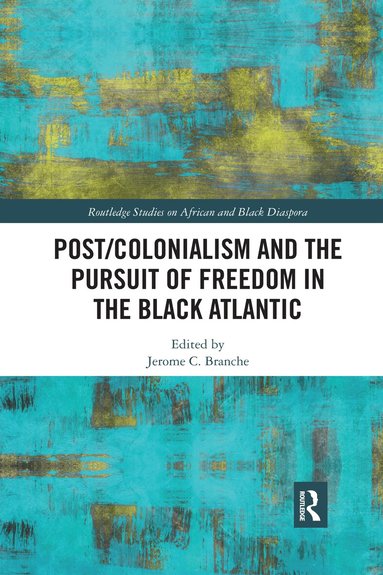
Mer från samma författare
Post/Colonialism and the Pursuit of Freedom in the Black Atlantic
Jerome C Branche
Inbunden, 2018
3 349 kr
Diversity in Higher Education Remote Learning
Paula K. Davis, Ellen R. Cohn, Jerome C. Branche
Inbunden, 2023
2 369 kr
Diversity in Higher Education Remote Learning
Paula K. Davis, Ellen R. Cohn, Jerome C. Branche
Häftad, 2024
2 369 kr
Hoppa över listan







Du kanske också är intresserad av
Trajectories of Empire
Jerome C. Branche, Elizabeth Wright, Cassia Roth, Baltasar Fra-Molinero, Miguel Valerio, Miguel Olmedo, Agnes Lugo-Ortiz, Lucia Helena Costigan, Abreu Alberto, Eliseo Jacob, Maria Andrea de Santos Soares, Jerome C. Branche
Inbunden, 2022
1 979 kr
Améfrica in Letters
Jennifer Carolina Gómez Menjívar, Paulette Ramsay, Juan Guillermo Sánchez Martínez, Michael Handelsman, Gloria Chacón, Ángela Castro, Eliseo Jacob, Isis Barra Costa, Juan Eduardo Wolf, Diana Rodríguez Quevedo, Mamadou Badiane, Jennifer Carolina Gómez Menjívar
Inbunden, 2022
2 219 kr
Améfrica in Letters
Jennifer Carolina Gómez Menjívar, Paulette Ramsay, Juan Guillermo Sánchez Martínez, Michael Handelsman, Gloria Chacón, Ángela Castro, Eliseo Jacob, Isis Barra Costa, Juan Eduardo Wolf, Diana Rodríguez Quevedo, Mamadou Badiane, Jennifer Carolina Gómez Menjívar
Häftad, 2022
769 kr
Valiant Black Man in Flanders / El valiente negro en Flandes
Baltasar Fra-Molinero Fra-Molinero, Baltasar Fra-Molinero, Manuel Olmedo Gobante
Häftad, 2025
869 kr
Valiant Black Man in Flanders / El valiente negro en Flandes
Baltasar Fra-Molinero, Manuel Olmedo Gobante
Inbunden, 2023
3 119 kr
Silviano Santiago y los estudios latinoamericanos
Lúcia Helena Costigan, Denilson Lopes
Häftad, 2015
989 kr