Del 10 i serien Balkan Studies Library
Traditions of Invention
Romanian Ethnic and Social Stereotypes in Historical Context
3 609 kr
Beställningsvara. Skickas inom 3-6 vardagar. Fri frakt för medlemmar vid köp för minst 249 kr.
Produktinformation
- Utgivningsdatum2013-06-07
- Mått155 x 235 x 24 mm
- Vikt619 g
- FormatInbunden
- SpråkEngelska
- SerieBalkan Studies Library
- Antal sidor310
- FörlagBrill
- ISBN9789004216174
Tillhör följande kategorier
Alex Drace-Francis is Associate Professor in the Literary and Cultural History of Modern Europe, University of Amsterdam. He is author of The Making of Modern Romanian Culture (2006) and co-editor of three books on East European travel writing. Most recently, he edited the collection of documents European Identity: A Historical Reader (2013).
- ContentsList of tables and illustrationsIntroductionISocial representations1.The traditions of invention. Representations of the Romanian peasant from ancient stereotype to modern symbol.IITravel and alterity2.A provincial imperialist and a curious account of Wallachia: Ignaz von Born 3.‘Like a member of a free nation, he spoke without shame’: Romanian discourses on the foreign traveller.4.‘At ten minutes past two, I gazed ecstatically on both lighthouses’: Time, self and object in early Romanian travel texts. 5.Constantin ‘Dinicu’ Golescu and his Account of My Travels (1826): Eurotopia as manifestoIIIMyths and discourses of the nation6.National ideology between lyrics and metaphysics: the political writings of Mihai Eminescu7.Ion Luca Caragiale and the tall tale of the Romanian nation IVAt the verbal frontiers of identity8.Eugen Ionescu’s selves9.Beyond the land of green plums: Romanian language and culture in Herta Müller’s workVEast-Westism in the Cold War age10.Sex, lies and stereotypes: British images of Romania since 1945. 11.Paradoxes of occidentalism: on travel and travel writing in Ceauşescu's Romania.Works CitedIndexList of tables and illustrationsTables2.1 Leipzig Valachica, 17742.2 Intercontinental ethnography in the London press, 17772.3 London popular pamphlets, 17792.4 Frameworks for comparison: Ignaz von Born’s other works10.1 Articles in The Times about Romania, 1996-1998Illustrations1.View of Schemnitz (Banská Štiavnica), site of Maria-Theresa’s Mining Academy (from R. Bright, Travels from Vienna through Lower Hungary, 1818)2.Emmanuel-Adolphe Midy ‘Le rencontre’, c. 1840. Encounter between a boyar of the older generation in Oriental dress, and a younger boyar in European dress. Detail from lithograph, Romanian Academy Library.3.A Wallachian boyar, c. 1830. Watercolour by Russian artist “R.G.A.I.”, Romanian Academy Library / www.europeana.eu /INTRODUCTIONThis book gathers a number of studies researched and written over the past fifteen years, on representations of Romanian culture from the beginnings of the modern age to the late twentieth century.In an earlier book, The making of modern Romanian culture (2006), I attempted an institutional, social-historical survey of the development and production of cultural output in the Romanian language over the eighteenth and nineteenth centuries. Here on the other hand, methods and approaches from literary and cultural history are used to elucidate a number of themes and topics in greater detail than could be achieved within a survey work. Case studies put the focus on individual actors and documents; or on specific social types or social practices, such as peasants, or travel. At the core of all of them is a focus on the topic of representations of self and other; on the subjective nature of these representations; and on the interplay between formal and informal discourses on identity. The book also offers a long-term approach. For, while the majority of the studies focus on the period from the late eighteenth century to the end of the nineteenth – Romanian history’s first ‘era of transition’ – an important theme is the persistence of older ideas, for reasons that are elaborated especially in the first chapter. At the same time, I have made significant inroads into the twentieth century, with four chapters dedicated to texts and cultural practices after 1900.Research contextThe study of modern Romanian culture in terms of its relations – whether active or passive, oppositional or integrational – to ‘Europe’, has a relatively long history. Pompiliu Eliade, writing at the end of the nineteenth century, saw this as an entirely one-way process. He described Western influence not in terms of a synthetic element or ‘graft’ of European ideas on existing roots, but as the force which actually brought a culture into existence where none had flourished before. Others perceived the matter differently, speaking of ‘an old and original civilization’ which nevertheless sought ‘respect’, being ‘not yet integrated into the general life of humankind’. Inter-war literary and cultural historian Eugen Lovinescu understood Romanian relations with Western Europe as a two-stage process, first of ‘imitation’, then of ‘synchronization’. A more neutral and popular term to describe Romanian cultural relations with Western Europe was ‘discovery’. Irrespective of their positions, however, pretty much all scholars agreed that issues of culture and identity – especially collective dignity in relation to the outside world – were important aspects of the modernization process that accompanied political independence and the creation of the national state. Since the 1960s, despite the constraints placed on research by the Communist regime, a tradition of ‘image studies’ developed in Romania. Significant documentary projects were undertaken, including a ten-volume collection of travellers’ accounts of the Romanian lands in the period to 1800. Scholars drew partly on the ‘mentalities’ paradigm, following the illustrious tradition of the Annales school, and partly on the traditions of literary image studies or ‘imagology’ developed in comparative literature circles. This was supplemented by some important contributions by foreign scholars, usually interested in the cultural dimension of their own countries’ relations with Romania. After the collapse of communism, this type of study flourished in Romania. Important and in some cases outstanding works were dedicated to such topics as the self-image of the Romanians in nineteenth-century schoolbooks; Hungarian attitudes to Romanians; Romanian images of Russians, Greeks or Jews, to name but a few. In the English-language scholarship of the same period, issues of geocultural identity and representation also came to the fore, although the scope and methodologies used were different. Works tended to focus less on reciprocal ethnic images than on broader culture areas such as Eastern Europe and the Balkans. Moreover, the inspiration was less from literary image studies than from postcolonial studies, especially Edward Said’s Orientalism. Perhaps especially in the circumstance of the Yugoslav conflict and the ensuing struggles over representation, questions of the political significance of images and the inequality of control over the means of disseminating them were special objects of scrutiny and debate. The trend generated some impressive scholarly studies which far transcend the immediate context and made constructive but not uncritical application of the Saidian paradigm to a geographically contiguous case. However, while all these authors touched on Romania, many texts still await systematic treatment in English. Moreover, the reception of the postcolonial paradigm by scholars in Romania has been somewhat half-hearted, perhaps because the implicit casting of Romania as a country subject to passive representations is something a number of scholars are somewhat uncomfortable with. In this collection I use aspects of ideas from the tradition of Orientalism and postcolonialism, following the insightful and pioneering work of the above-cited scholars. Indeed, unlike some of my colleagues, I don’t believe it is always necessary to establish a paradigm of ‘Balkanism’ fundamentally distinct from Orientalism. But at the same time my approach is not subordinate to any one tradition and tries to adapt the theory to the relevant case study material. Verbal representations of Romania, whether self-images or ones produced by outsiders, cannot be easily understood in a monolithic way. In fact they may belong simultaneously to a set discourses about Europe and its boundaries, and to ones about the Orient; while it is equally important to bear in mind that neither of these main paradigms can offer definitive answers, and statements about Romanian identity may easily have quite other meanings. Simple inventories of images drawn from heterogeneous sources do not always take account of the different functions they play within specific narrative contexts.
"Inspirational for historians, literary scholars, and social scientists interested in travel, myths, representations and identity, irrespective of the regional focus of their expertise. Recommended readings for specialists and non-specialists alike."Mónika Baár in English Historical Review, February 2017"Overall, Drace-Francis’s study stands out first and foremost through his ability to ask the most pressing questions on a subject, to single out the key dilemmas, and to open up relevant paths for future investigation."Monica Spiridon (University of Bucharest) on H-Nationalism (February, 2016)(full review text: http://www.h-net.org/reviews/showrev.php?id=45985) "These well-researched essays, taken together, make useful additions to aspects of Romanian cultural historiography and invite further inquiry. The author’s analyses of literary texts suggest productive avenues for more deeply understanding the intellectual climate of the times, and he has made a strong case for the value of travel literature as a historical source.Keith Hitchins, University of Illinois, Urbana-Champaign, in Slavic Review Vol. 73, No. 2 (Summer 2014), pp. 411-412(full review text: http://www.jstor.org/stable/10.5612/slavicreview.73.2.411)"With his stimulating analyses, Drace-Francis opens up new approaches to many aspects of Romanian identity, as perceived both from the inside and the outside."Klaus Steinke in IFB, Digitales Rezensionsorgan für Bibliothek und Wissenschaft(full review text: http://ifb.bsz-bw.de/bsz399138900rez-1.pdf?id=6272)"L’insieme di questi saggi, che nei contenuti presentano temi, personaggi e periodi molto differenti, offre un esempio ricco e articolato della complessità legata alla questione dell’identità romena. In particolare Drace-Francis dimostra come l’identità e la rappresentazione dell’altro non si possano concepire in maniera monolitica, bensì soltanto nella complessità e pluralità di rimandi fra culture e discorsi differenti, a loro volta espressione di motivazioni, contesti e narrazioni specifiche, che se da un lato impediscono di dare una risposta definitiva su una questione precisa, dall’altro hanno il merito di favorire una conoscenza lontana da quegli stereotipi messi sotto la lente d’ingrandimento dell’autore in questo volume.Antonio d’Alessandri in Nuova Rivista Storica, XCIX, III, 2015, pp 1087-8
Mer från samma författare
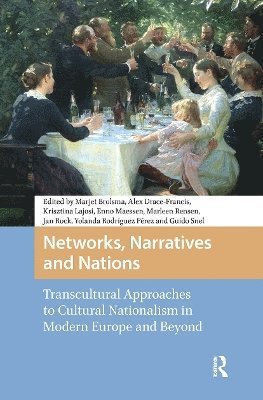
Networks, Narratives and Nations
Marjet Brolsma, Alex Drace-Francis, Krisztina Lajosi-Moore, Enno Maessen, Marleen Rensen
859 kr
Networks, Narratives and Nations
Marjet Brolsma, Alex Drace-Francis, Krisztina Lajosi-Moore, Enno Maessen, Marleen Rensen, Jan Rock, Yolanda Rodríguez Pérez, Guido Snel
729 kr
Mer från samma serie
Entangled Histories of the Balkans - Volume Three
Roumen Daskalov, Alexander Vezenkov
4 239 kr
Entangled Histories of the Balkans - Volume Four
Roumen Dontchev Daskalov, Diana Mishkova, Tchavdar Marinov, Alexander Vezenkov
4 599 kr
Women, Consumption, and the Circulation of Ideas in South-Eastern Europe, 17th - 19th Centuries
Constanţa Vintilă-Ghiţulescu
2 529 kr
Du kanske också är intresserad av
Search for a Cold War Legitimacy: Foreign Policy and Tito's Yugoslavia
Robert Edward Niebuhr
2 529 kr
Women, Consumption, and the Circulation of Ideas in South-Eastern Europe, 17th - 19th Centuries
Constanţa Vintilă-Ghiţulescu
2 529 kr
Entangled Histories of the Balkans - Volume Four
Roumen Dontchev Daskalov, Diana Mishkova, Tchavdar Marinov, Alexander Vezenkov
4 599 kr