
Surveillance and the Dossier
Record Keeping, Vulnerability, and Reputational Politics
Inbunden, Engelska, 2026
1 019 kr
Beställningsvara. Skickas inom 5-8 vardagar. Fri frakt för medlemmar vid köp för minst 249 kr.
Surveillance and the Dossier delves into how dossiers, both paper-based and digital, have been used by governments both historically and in contemporary times to inflict various forms of violence upon the public, including psychological, physical, and reputational. This volume establishes dossier creation as the foundational practice of all bureaucracies, despite differences in how it has been weaponized as a technique of power by different systems. In nine case studies, ranging from police dossiers in Nazi Germany to China's Hukou family dossier system, this book examines the evolution of surveillance in societies. Surveillance and society researchers Cristina Plamadeala and Özgün Erdener Topak engage in a diverse yet comprehensive study of this surveillance tool, looking at examples such as dossiers implicating former members of Zimbabwe's Central Intelligence Organization (CIO), dossiers used in Cold War-era Australia to monitor migrants from the Soviet Union, dossiers of colonial Japan’s Unit 731, deployed in Manchukuo, in Northeast China, and dossiers mobilized for Canada’s World War II conscription program. Deeply relevant and imperative, Surveillance and the Dossier seeks to understand the links between the infliction of state-violence and surveillance.This book demonstrates that dossiers serve as a valuable platform for understanding the past and present of surveillance societies across governments and countries.
Produktinformation
- Utgivningsdatum2026-05-19
- Mått159 x 235 x 22 mm
- Vikt560 g
- FormatInbunden
- SpråkEngelska
- Antal sidor298
- FörlagUniversity of Toronto Press
- ISBN9781487542153
Tillhör följande kategorier
Hoppa över listan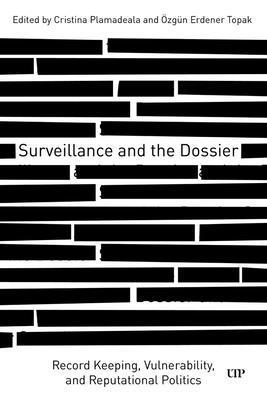







Du kanske också är intresserad av
- Nyhet
- Nyhet
Del 3
- Nyhet
Del 11
- Nyhet
Del 6
Del 1
- Nyhet
Del 4
Del 3
Del 2