Beställningsvara. Skickas inom 10-15 vardagar. Fri frakt för medlemmar vid köp för minst 249 kr.
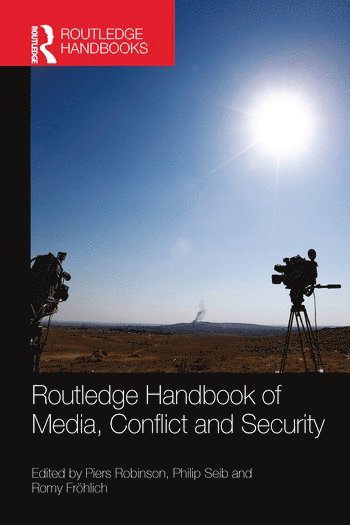
This Handbook links the growing body of media and conflict research with the field of security studies. The academic sub-field of media and conflict has developed and expanded greatly over the past two decades. Operating across a diverse range of academic disciplines, academics are studying the impact the media has on governments pursuing war, responses to humanitarian crises and violent political struggles, and the role of the media as a facilitator of, and a threat to, both peace building and conflict prevention. This handbook seeks to consolidate existing knowledge by linking the body of conflict and media studies with work in security studies.The handbook is arranged into five parts:Theory and Principles.Media, the State and WarMedia and Human SecurityMedia and Policymaking within the Security StateNew Issues in Security and Conflict and Future DirectionsFor scholars of security studies, this handbook will provide a key point of reference for state of the art scholarship concerning the media-security nexus; for scholars of communication and media studies, the handbook will provide a comprehensive mapping of the media-conflict field.
Piers Robinson is Professor of Politics, Society and Political Journalism at the University of Sheffield, UK. Philip Seib is Professor of Journalism and Public Diplomacy and Professor of International Relations at the University of Southern California, USA. Romy Fröhlich is Professor of Communication Science and Media Research at Ludwig-Maximilians-University Munich, Germany.
Introduction, Piers Robinson, Phil Seib and Romy FröhlichPART I: Theory and Principles1. Secrets and Lies: on the ethics of conflict coverage, Richard Keeble2. Gender, Media, and Security, Romy Fröhlich 3. Investigating the Culture-Media-Security Nexus, Holger Pötzsch 4. The Media-Security Nexus: Researching Ritualised Cycles of Insecurity, Ben O’Loughlin and Marie Gillespie5. Critical Perspectives on Media and Conflict, Des Freedman6. Theorising Media/State Relations and Power, Phil HammondPART II: Media, the State and War7. Visual Truths: Online News and Conflict Reporting, Stuart Allan and Chindu Sreedharan8. Media, War, and Public Opinion, Sean Aday 9. Theorizing State-media Relations During War and Crisis, Steven Livingston10. Media, Dissent, and Anti-War Movements, Andrew Rojecki 11. Public Diplomacy, Craig Hayden12. Mapping a century in media coverage of war and conflict, Peter Goddard and Katy Parry PART III: Media and Human Security13. Citizen Voice in War and Conflict Reporting, Lilie Chouliaraki14. The CNN effect and Humanitarian Action, Piers Robinson 15. News coverage, peacemaking and peacebuilding, Jake Lynch 16. Continuing Post-Conflict Coverage, Marie-Soleil Frère 17. Media and Human Rights, Ekaterina BalabanovaPart IV Media and Policymaking within the Security State18. News media and the intelligence community, Vian Bakir19. Covering acts of terrorism, Heather Epkins20. Cybersecurity, Myriam Dunn Cavelty21. Social Media and Revolution, Philip Howard & Samuell Woolley PART V: New Issues in Security and Conflict and Future Directions22. Media, the Environment, and Global Security, Neil Gavin 23. Contemporary Propaganda and Persuasion During Conflict, David Miller, Piers Robinson and Vian Bakir24. The Responsibility to Protect Doctrine and the World’s Press: a new development in human security?, Simon Cottle with the assistance of Charles Martin Hughes25. Conclusion: Looking ahead, Piers Robinson, Phil Seib and Romy Fröhlich