
Popular Music in Contemporary Bulgaria
At the Crossroads
Inbunden, Engelska, 2019
1 289 kr
Beställningsvara. Skickas inom 5-8 vardagar. Fri frakt för medlemmar vid köp för minst 249 kr.
Bulgarian popular music, the meanings it articulates, and the infrastructures of its creation, operates within a web of inter-dependencies with changing social and political contexts. Positioned on the edge of Europe, between the cultural constructs of the 'East' and 'West', Bulgarian popular music negotiates the complexities of perceived 'global' values and specificities of the 'local'. This book takes an ethnographic approach to qualitative methodologies to create a mosaic of perspectives through the participation of music artists, critics, business figures, copyright specialists, and young audiences. It employs the metaphor of the 'crossroads' to describe the realities of the contemporary Bulgarian popular music field, developed amidst the prolonged transitions that followed the communist era. In the context of struggles for social change, popular music has participated in the creation of rituals and symbols of protest and resistance. At the same time, the new market environment created opportunities for popular music to formulate a business approach to producing standardised content. The Balkans, are a melting pot of music traditions, but are also framed as pathologically different from the rest of Europe. This book suggests that an internalised negative stereotype adds tacit complexities to Bulgarian popular music, while at the same time, expressive markers of identity, such as folklore and language, are celebrated.
Produktinformation
- Utgivningsdatum2019-03-07
- Mått152 x 229 x 15 mm
- Vikt471 g
- FormatInbunden
- SpråkEngelska
- SerieEmerald Studies in Alternativity and Marginalization Book Set (2017-2019)
- Antal sidor248
- FörlagEmerald Publishing Limited
- ISBN9781787436978
Tillhör följande kategorier
Hoppa över listan


Du kanske också är intresserad av
Gender and Contemporary Horror in Comics, Games and Transmedia
Robert Shail, Samantha Holland, Steven Gerrard
Inbunden, 2019
1 339 kr
Gender and Contemporary Horror in Film
Samantha Holland, Robert Shail, Steven Gerrard
Inbunden, 2019
1 339 kr
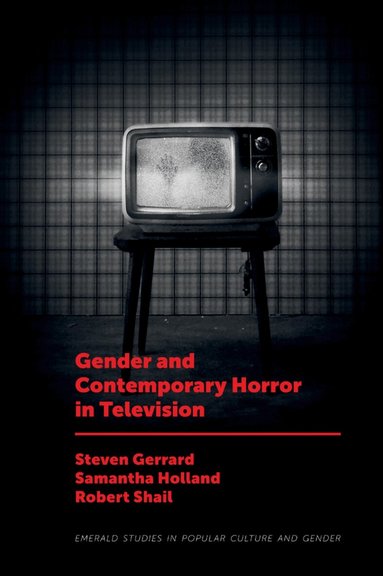
Gender and Contemporary Horror in Television
Steven Gerrard, Samantha Holland, Robert Shail
Inbunden, 2019
1 339 kr