
Del i serien Routledge Studies in Medieval Literature and Culture
Polyphony and the Modern
Häftad, Engelska, 2023
1 059 kr
Beställningsvara. Skickas inom 10-15 vardagar. Fri frakt för medlemmar vid köp för minst 249 kr.
Polyphony and the Modern asks one fundamental question: what does it mean to be modern in one’s own time? To answer that question, this volume focuses on polyphony as an index of modernity.In The Principle of Hope, Ernst Bloch showed that each moment in time is potentially fractured: people living in the same country can effectively live in different centuries – some making their alliances with the past and others betting on the future – but all of them, at least technically, enclosed in the temporal moment. But can a claim of modernity also mean something more ambitious? Can an artist, by accident or design, escape the limits of his or her own time, and somehow precociously embody the outlook of a subsequent age?This book sees polyphony as a bridge providing a terminology and a stylistic practice by which the period barrier between Medieval and Early Modern can be breached.Chapter 1 of this book is freely available as a downloadable Open Access PDF under a Creative Commons Attribution-Non Commercial-No Derivatives 4.0 license available at https://www.taylorfrancis.com/books/edit/10.4324/9781003129837
Produktinformation
- Utgivningsdatum2023-05-31
- Mått152 x 229 x 15 mm
- Vikt453 g
- FormatHäftad
- SpråkEngelska
- SerieRoutledge Studies in Medieval Literature and Culture
- Antal sidor266
- FörlagTaylor & Francis Ltd
- ISBN9781032006642
Tillhör följande kategorier
Hoppa över listan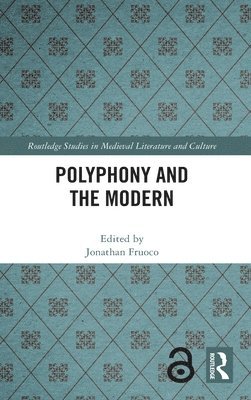




Du kanske också är intresserad av
Storytelling as Plague Prevention in Medieval and Early Modern Italy
Martin Marafioti
Inbunden, 2017
3 699 kr
- Nyhet
Del 11
- Nyhet
Del 3
- Nyhet
Del 6
Cultural Difference and Material Culture in Middle English Romance
Dominique Battles
Häftad, 2019
1 039 kr