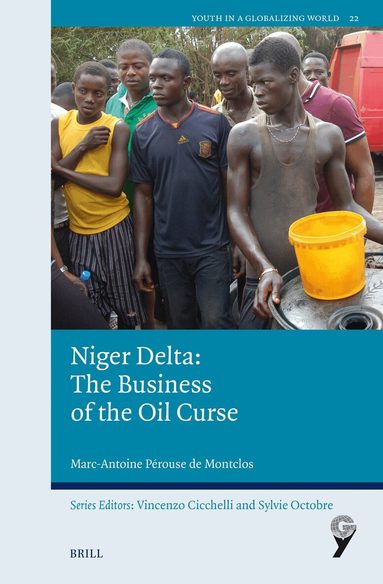
Based on 30 years of fieldwork in the Niger Delta, this book debunks the determinism of the resource curse theory in Nigeria, Africa's leading oil producer and the most populous country on the continent. It rather shows that oil and gas production is only one element of a social problem with much deeper roots. It also investigates the role played by the youth, a key issue in a society where half of the population is under 18 years old. To understand the multiple causes of the crisis, it thus delves into the complexity of a rich history.
Marc-Antoine Pérouse de Montclos is a Senior Researcher at the Institut de recherche pour le développement (IRD) in Paris, a Doctor in political science and a specialist on armed conflicts in Africa. He graduated from the Institut d’études politiques in Paris (IEP) and lived during several years in Nigeria, South Africa and Kenya.
PrefaceAcknowledgementsList of Maps, Figures and TablesAcronymsIntroductionPart 1From Ebony to Black Gold: A Turbulent History1 First Stirrings Nigerian Independence and the Niger Delta Republic (1960–1966)1 From the Slave Trade2 To Oil Exploration3 Isaac Boro and the Niger Delta Republic (1966)4 Toward the Secession of Biafra5 Controversies Surrounding the Question of Genocide.2 Mirages in the Midst of War The Secession of Biafra (1967–1970)1 The Great Game of Alliances2 The Pragmatism of Oil Companies3 Oil: A Resource for Conflict or an Obstacle to War?4 Disagreements over Revenue Sharing3 Boom or Doom? From Prosperity to the Economic and Social Crisis (1971–1989)1 The Reconstruction Era2 A Relentless Race to Create New States3 Centralized Federalism4 The Uprising of Evangelists, Naked Women and the Youth4 Shell, the Dictator and the Writer The Ogoni Revolt (1990–1999)1 The Ogoni, an Emerging Minority2 mosop between Contestations and Divisions3 A Bitter Victory4 The Odi Massacre and the Beginning of the Ijaw Rebellion5 Militants or Pirates? The Armed Struggle of the Ijaw (2000–2009)1 Greed or Grievance?2 The Emergence of mend (2006–2008)3 The 2009 Amnesty6 The Gangster and the Godfather Ordinary Crime and Amnesty in a “Democracy” (2010–2020)1 An Ijaw President: Goodluck Jonathan (2010–2015)2 Muhammadu Buhari, or the Dashed Hopes of a Democratic Transition (2015–2020)3 The Business of Amnesty4 The Institutionalization of Crime5 Bayelsa and Rivers in Troubled WatersPart 2And What about Oil?7 In Search of Lost Oil Dutch Disease under the Tropics1 Biased Analyses2 Toward a Pluralistic Interpretation of Nigeria’s Problems3 Godfatherism by Way of Democracy4 Oil and Violence: A Complex Relationship8 The End of the Trinity The State, Oil Companies, and “Civil Society”1 Cult Societies2 On the “Irresponsibility” of Oil Companies in the Violence3 The Use of Militias and Security Contracts: Corporate Contributions to Crime4 Three Divided “Blocs”5 The Unions9 Majors, Domestic Firms, and the National Company A Multifaceted Industry1 Oil Production: A Wide Range of Actors2 Transnational Corporations3 “Independent” and “Indigenous” Operators4 A Highly Political Nigerianization of the Industry since 19995 Reforms in Progress10 Ruling without Governing The Challenges of Acephalous Societies1 An Ethnic Puzzle2 Warrant Chiefs and Indirect Rule3 Political Careers and Crowns4 The Case of Warri11 Dividing without Ruling Beyond Ethnicity1 The Ibo and the Ijaw: Two Different Agendas2 Discord among the Rebels3 Tribalism and Politics4 Quotas, or the Illusions of IndigeneityPart 3The Heart of the Matter The State12 Big Business and Political Power An Uneasy Alliance1 Conflicts between Oil Companies and the State2 Corporate Social Responsibility (csr)3 From Collusion to Separation13 The Leviathan of the Mangroves A Deficient, Predatory, and Contested State1 A Sense of Alienation2 Land as a Key Bone of Contention3 A Deficient Judicial System4 When Crime Pays: The Reign of Impunity14 “Authority Stealing” Corruption as a System of Government1 A Model of Maladministration2 The Merits and Drawbacks of Cronyism3 Flexible Perceptions4 The Contradictions of the “Marginalization” Argument15 Pollution Who Is to Blame?1 A Degraded Environment2 Multinationals in the Eye of the Storm3 Shared Responsibilities4 Between Impotence and Conflicts of Interest: The Role of the State16 Incoherence and Fantasy A Versatile Elite1 On Collusion with Rebels2 Independence, Autonomy, Regionalism, Federalism: An à la Carte Menu3 Everyday Arrangements: The Obolo between the Ocean and the Niger Delta4 The Balkanization of the Niger DeltaConclusionAnnex 1 Overview of “Cult” Societies in Nigeria: From Students’ Fraternities to Street GangsAnnex 2 Three Examples of Domestic CompaniesIndex